You’ve probably come across RFID technology more often than you think. Whether it’s crossing a FASTag toll lane without stopping, tapping your office access card, or checking where your parcel has reached, RFID is working quietly in the background.
RFID, or Radio Frequency Identification, is a wireless technology that uses radio waves to identify, track, and manage objects automatically. Unlike traditional barcode systems, RFID does not require direct line of sight and can scan multiple items simultaneously. This makes it one of the most efficient technologies for inventory management, asset tracking, automation, and supply chain visibility.
Today, RFID is transforming industries such as retail, logistics, healthcare, manufacturing, transportation, and agriculture. From FASTag toll collection systems in India to smart retail inventory management worldwide, RFID has become a critical part of modern operations.
In this complete guide, we will explain what RFID is, how RFID technology works, different types of RFID tags and readers, RFID vs. barcode comparisons, and the future trends shaping the RFID industry in 2026 and beyond.
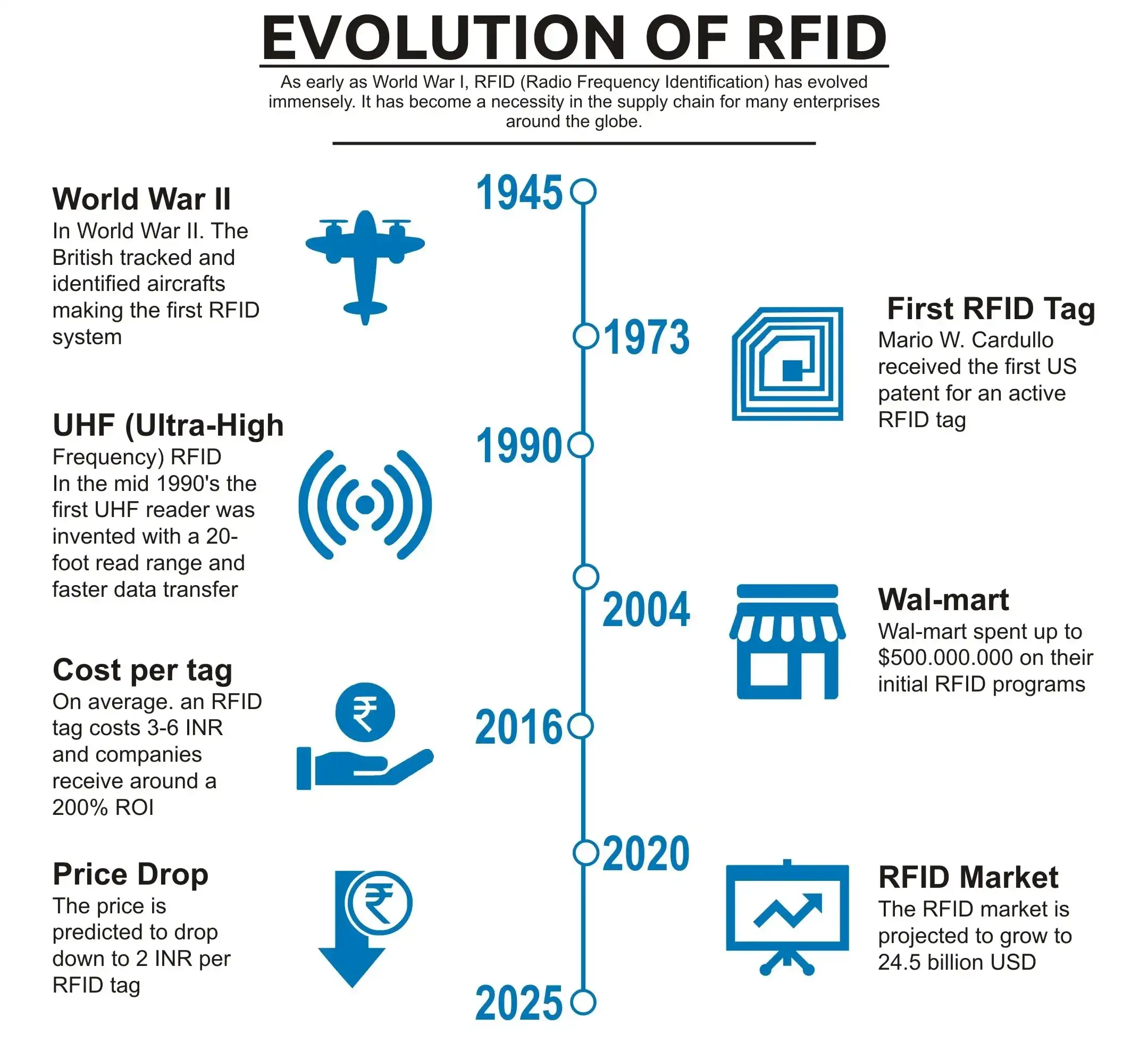
RFID technology is not new. It first originated from military aircraft identification systems developed during World War II. As technology improved and costs reduced, RFID slowly became a key part of industries like retail, logistics, manufacturing, and automation. Today, RFID is driving digital transformation across global supply chains by enabling faster tracking, better visibility, and smarter operations.
Table of Contents
What is RFID?
RFID stands for Radio Frequency Identification. It is a technology that uses electromagnetic radio waves to automatically identify and track tags attached to objects.
An RFID system can identify products, assets, vehicles, animals, or even people without requiring physical contact or direct visibility. This is one of the biggest advantages of RFID over traditional barcode systems.
RFID technology is widely used because it offers:
- Fast and automatic data collection
- Bulk scanning capability
- Real-time tracking
- Reduced manual errors
- Better operational visibility
- Improved inventory accuracy
Unlike barcodes that require one-by-one scanning, RFID can read hundreds of tags in seconds.
Types of RFID Frequencies
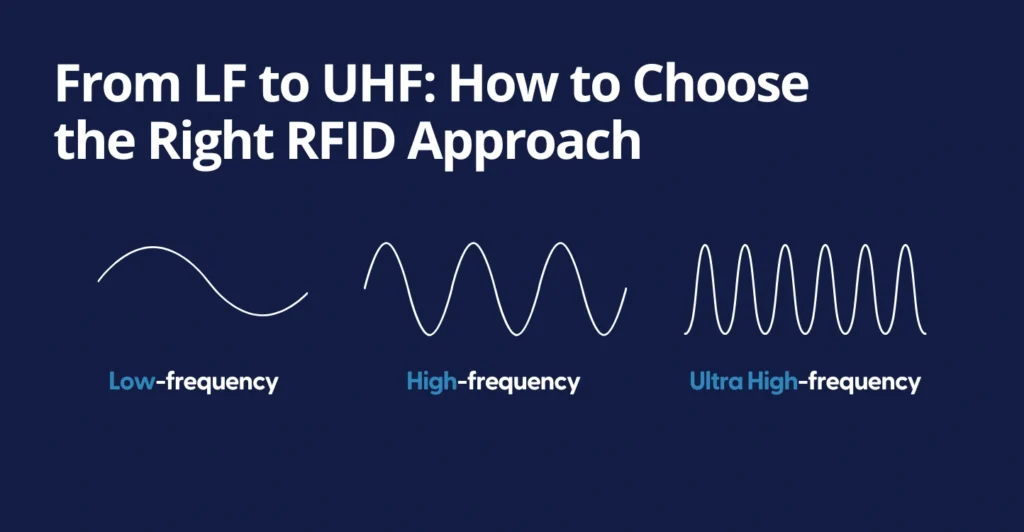
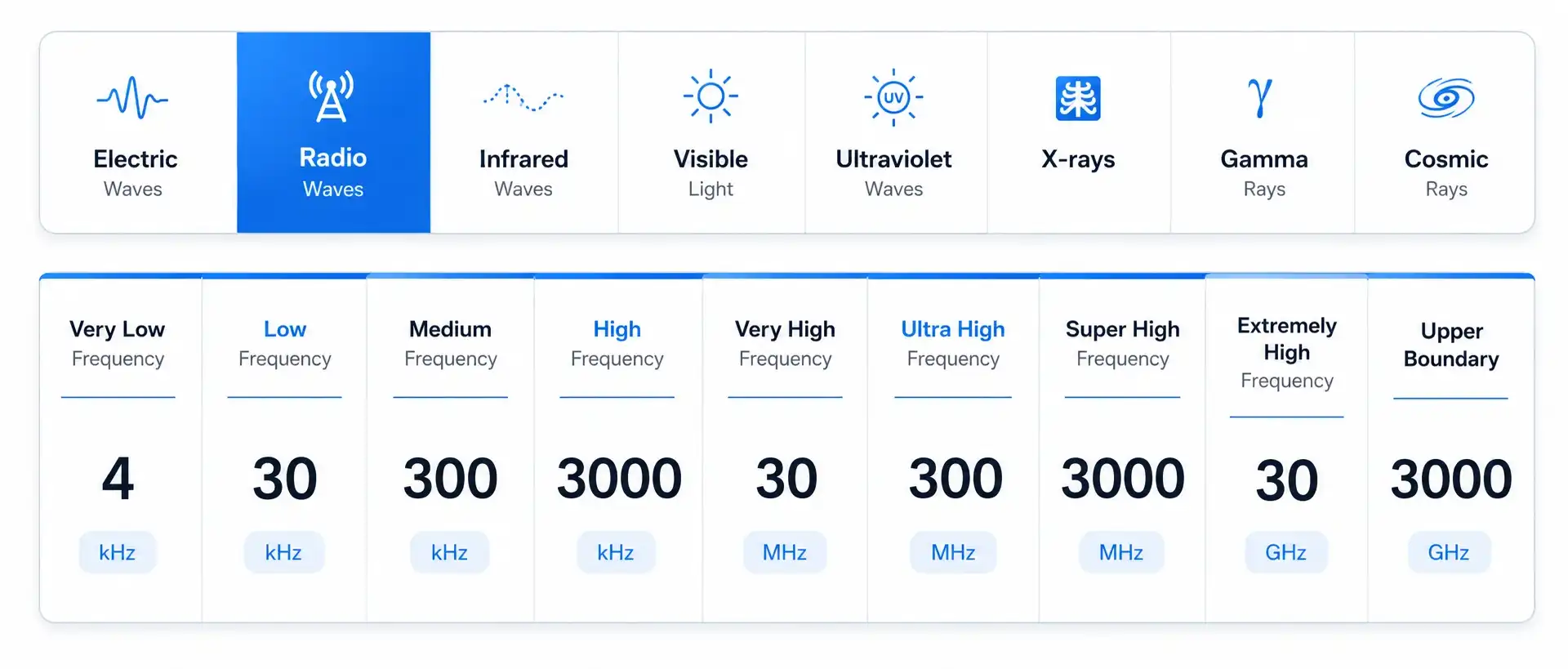
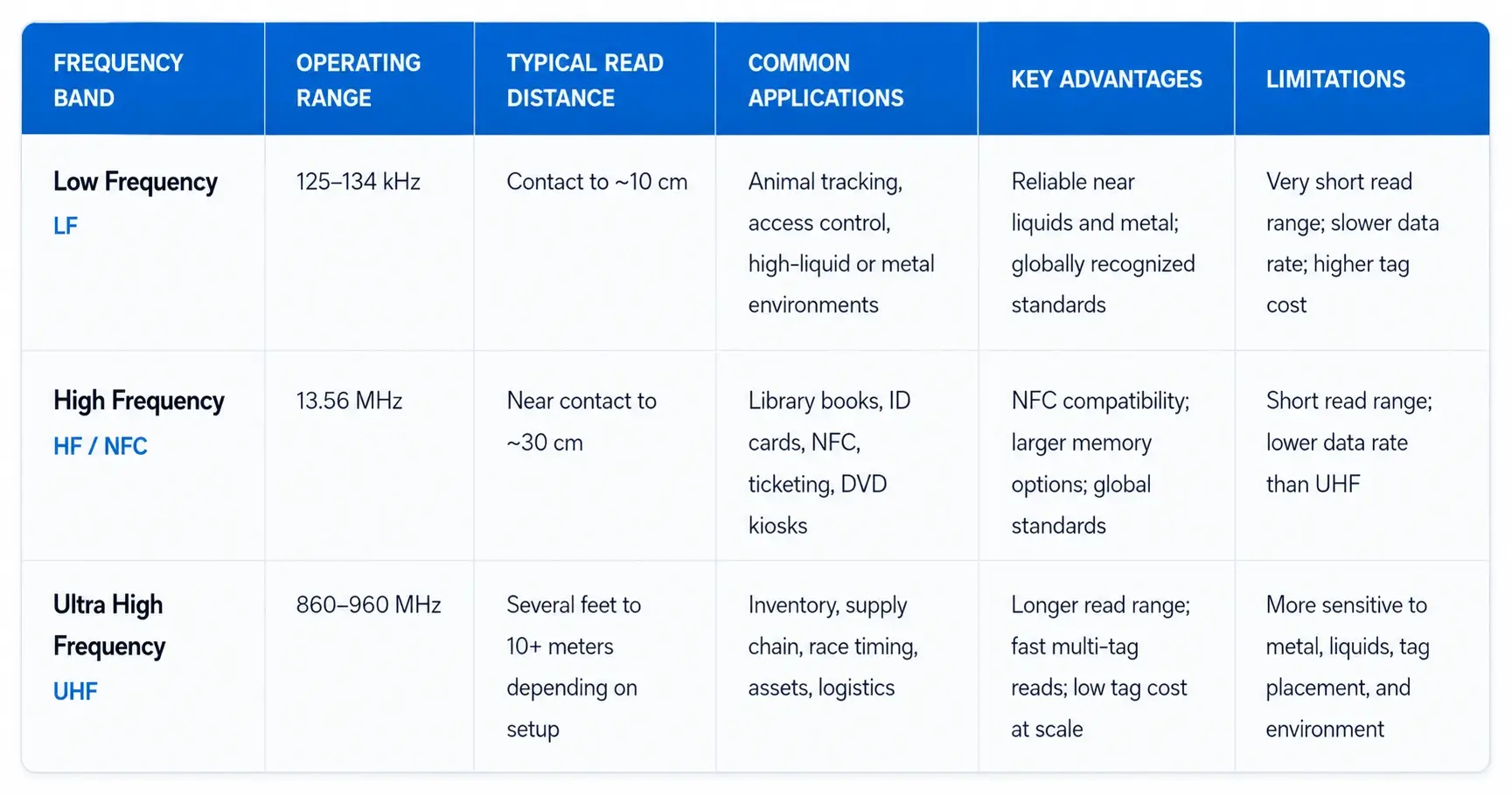
RFID technology operates across three primary frequency ranges, each offering different read ranges, performance characteristics, costs, and application suitability. Selecting the right RFID frequency is important to ensure optimal performance for specific use cases and environments.
Electromagnetic Spectrum & RFID Frequencies
Ultra-High Frequency (UHF): Active vs. Passive RFID
Within the UHF RFID spectrum, there are two main categories: Active RFID and Passive RFID. Both technologies operate differently and are selected based on factors such as read range, infrastructure, cost, and application requirements.
| Parameter | Active RFID | Passive RFID |
| Frequency | 433 MHz / 2.45 GHz | 860 – 960 MHz |
| Read Range | 30 to 100+ meters | Near contact to 25 meters |
| Tag Cost | $15 – $50 | $0.08 – $20 |
| Power Source | Battery-powered | Powered by RFID reader |
| Ideal Applications | Vehicle tracking, mining, cargo/container monitoring, auto manufacturing, construction equipment tracking | Inventory management, pharmaceuticals, tolling, race timing, IT assets, tool tracking, laundry management, access control |
| Considerations | Higher tag cost, battery maintenance, shipping restrictions, complex software integration | Higher infrastructure investment, performance may be affected near metal and liquids |
Passive UHF RFID: Regional Frequency Standards
Passive UHF RFID globally operates within the 860 – 960 MHz band. However, frequency allocation differs by region based on local regulations.
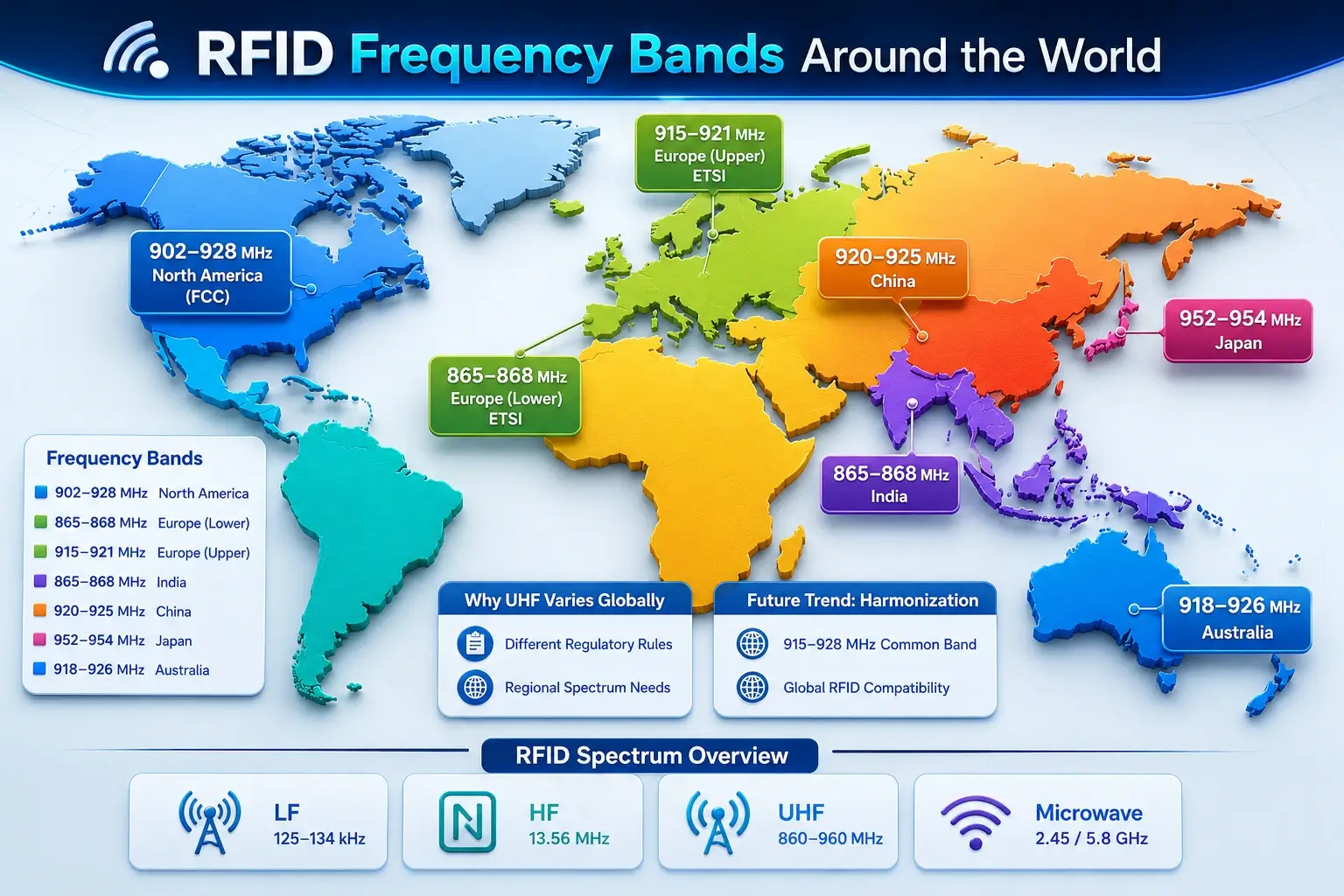
Several countries follow either FCC or ETSI standards, while some define their own regional frequency subsets.
RFID Technology: How Does It Work?
RFID technology may sound complex, but the working principle is actually very simple.
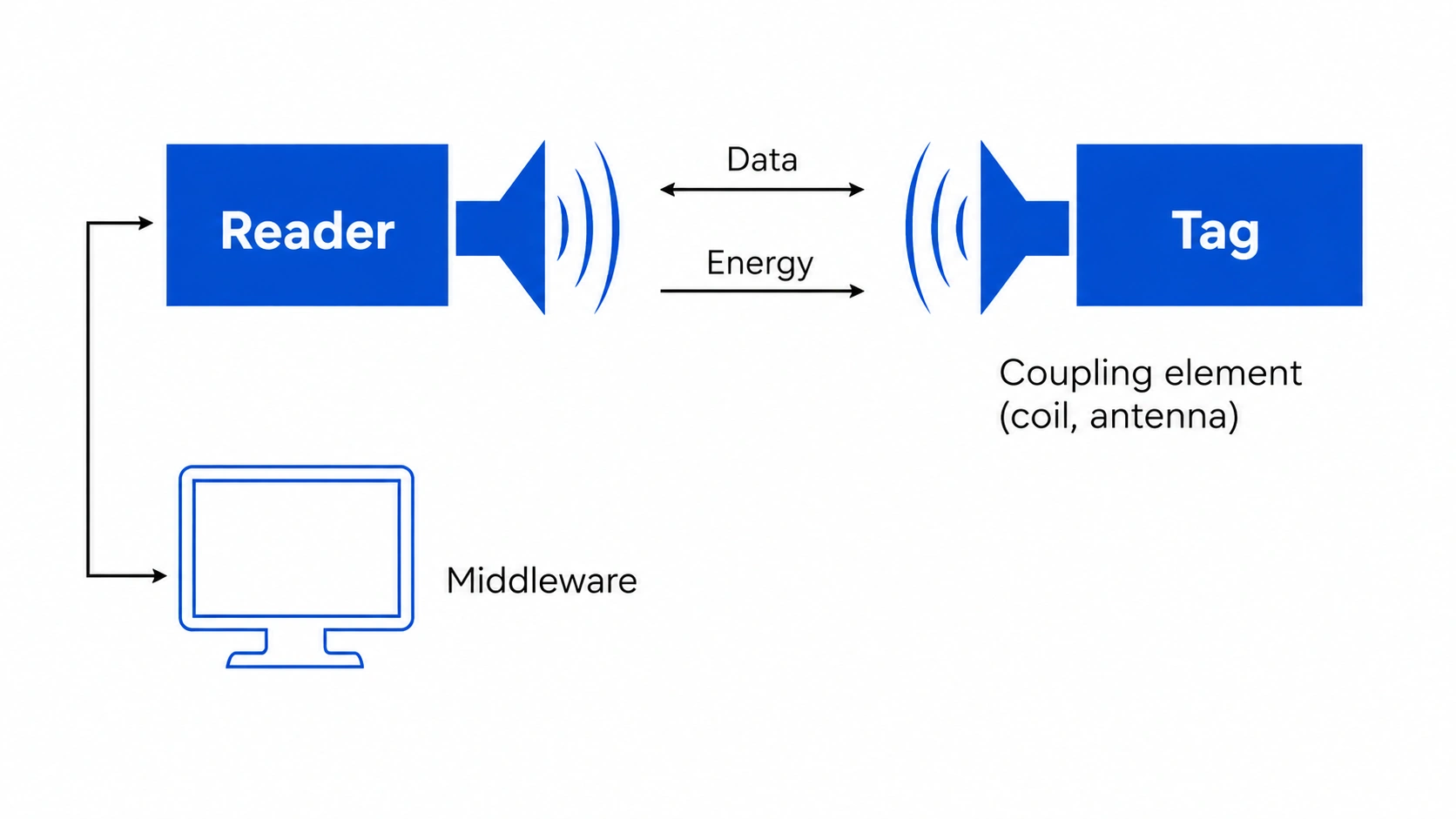
An RFID system mainly consists of four components:
- RFID Tags
- RFID Readers
- RFID Antennas
- Middleware or Software
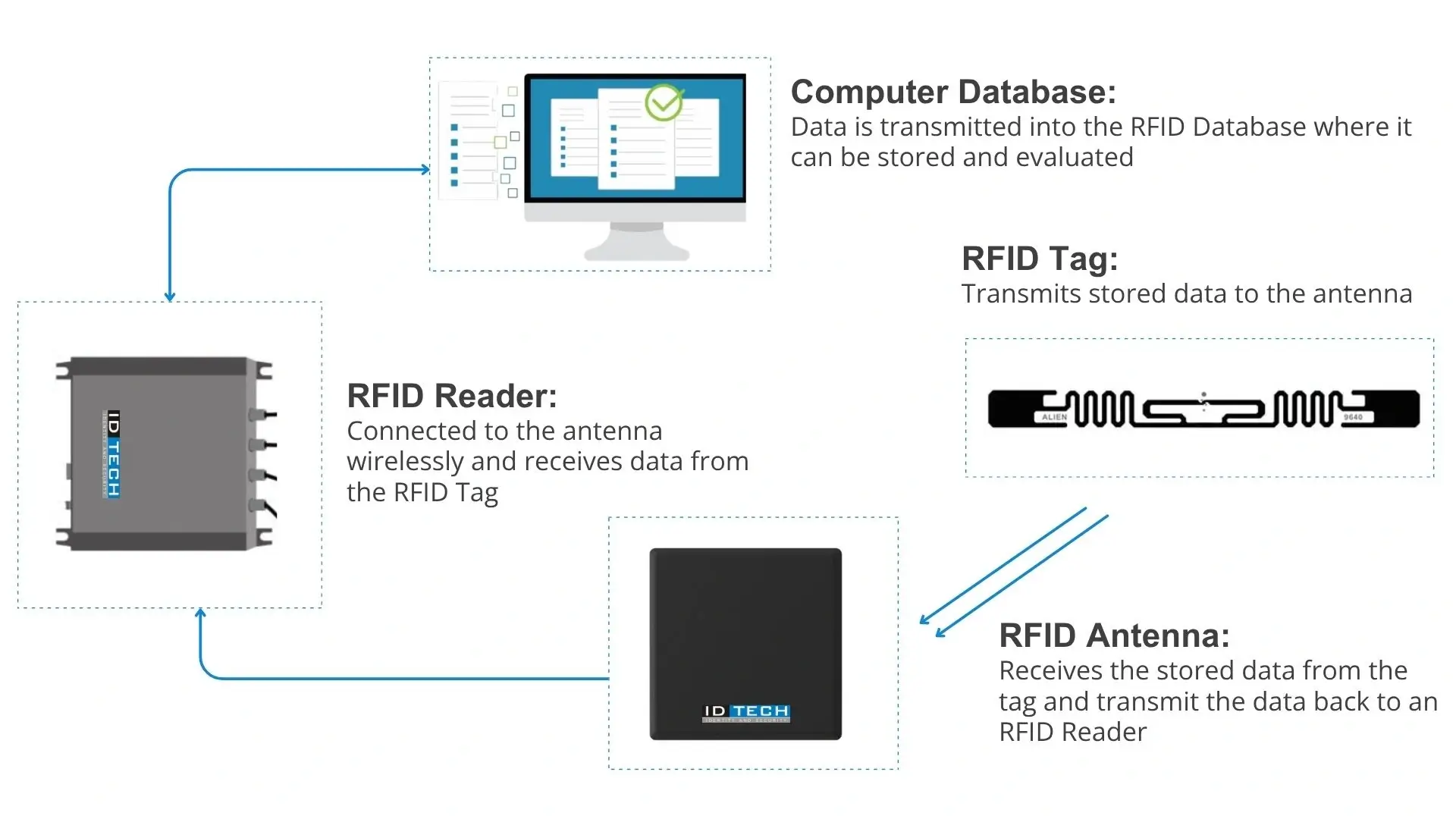
Here is how the process works step by step:
Step 1: RFID Reader Sends Radio Signals
The RFID reader sends radio frequency signals through an antenna. These radio waves create a communication zone around the reader.
Step 2: RFID Tag Gets Activated
When an RFID tag enters the reader’s range, the tag antenna captures the radio energy. Passive RFID tags use this energy to power the chip inside the tag.
Step 3: Tag Responds with Data
The RFID tag sends back information stored in its chip. This data may include:
- Product ID
- Serial number
- Asset information
- Location data
Step 4: Reader Receives the Data
The RFID reader captures the tag response and transfers the information to middleware or software systems.
Step 5: Software Processes the Information
The software filters, stores, analyzes, and displays the information on dashboards or ERP systems for business operations.
One major advantage of RFID is that it does not require line of sight. Tags can often be read even when placed inside boxes, cartons, or packaging materials.
Modern RFID systems can also read multiple tags at the same time, making them highly efficient for warehouses, logistics hubs, and retail operations.
Today, technologies like RAIN RFID are helping businesses achieve large-scale item-level visibility across global supply chains.
Components of RFID Technology
An RFID system is made up of multiple components working together to create a seamless tracking ecosystem.
What are RFID Tags?
RFID tags are electronic devices used to identify and track assets, inventory, tools, and products using radio frequency signals. They communicate with RFID readers and antennas without requiring direct line of sight, making them suitable for retail, logistics, healthcare, manufacturing, tolling, warehouse management, and industrial automation applications.
For a detailed technical understanding of RFID tags, memory structure, frequencies, and tag selection, read our complete blog here: RFID Tags: Understanding the Technical Aspects
RFID Tag Memory Banks
Most UHF RFID tags contain four memory banks inside the RFID chip:
| EPC Memory Bank : Stores the Electronic Product Code (EPC) used for identifying tagged items. | TID Memory Bank : Contains the permanent Tag Identifier programmed by the manufacturer. |
| User Memory Bank: Used for storing additional user-defined information like serial numbers, maintenance history, or asset details. | Reserved Memory Bank: Stores access and lock passwords used for tag security and memory protection. |
Types of RFID Tags
RFID Labels & Inlays
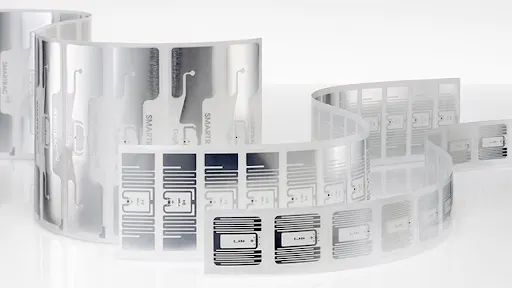
Thin and flexible RFID tags mainly used for retail, carton tracking, inventory management, and logistics.
What’s Inside an RFID Tag?
A standard UHF RFID tag is built using multiple layered components that work together to enable wireless identification and data transmission
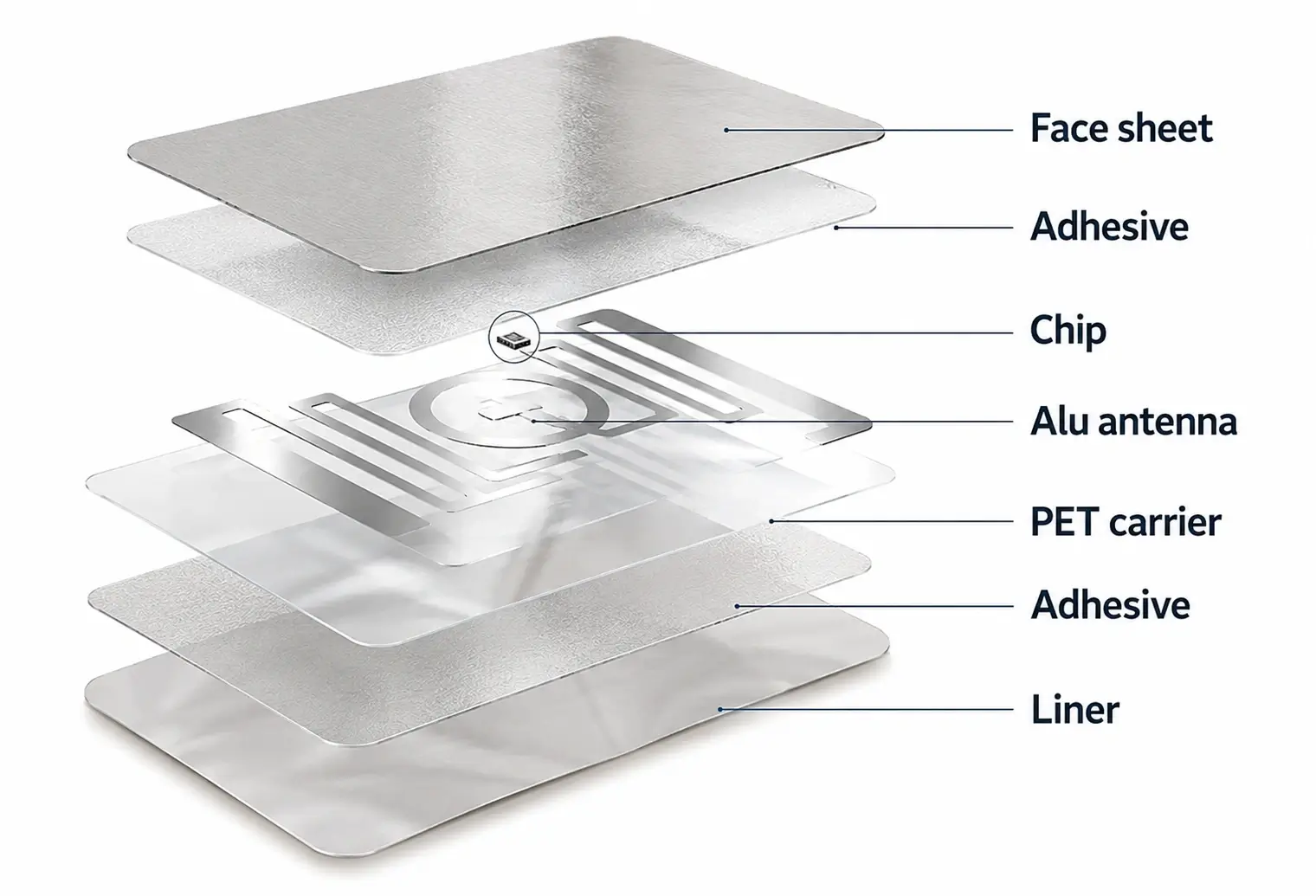
Face Sheet
The top printable layer of the RFID tag that protects the internal components and allows branding, barcode printing, or human-readable information.
Adhesive Layer
A bonding layer used to attach and secure the internal RFID structure between materials while maintaining flexibility and durability.
Integrated Circuit (IC) / Chip
The RFID chip acts as the brain of the tag. It stores and processes data, manages communication with the RFID reader, and supports anti-collision protocols for reading multiple tags simultaneously. Different ICs offer varying memory capacities and functionalities.
Aluminum Antenna
The antenna receives radio frequency (RF) signals from the RFID reader, powers the chip, and transmits data back through backscatter communication. Antenna design directly impacts read range and performance.
PET Carrier
A transparent PET substrate that supports and holds the antenna and chip assembly in place while providing structural stability.
Bottom Adhesive
An additional adhesive layer used for mounting the RFID inlay onto different surfaces or label constructions.
Liner
The protective backing layer that covers the adhesive before the RFID label or tag is applied to the final product or surface.
RFID Hard Tags
Rugged RFID tags designed for industrial and outdoor environments.
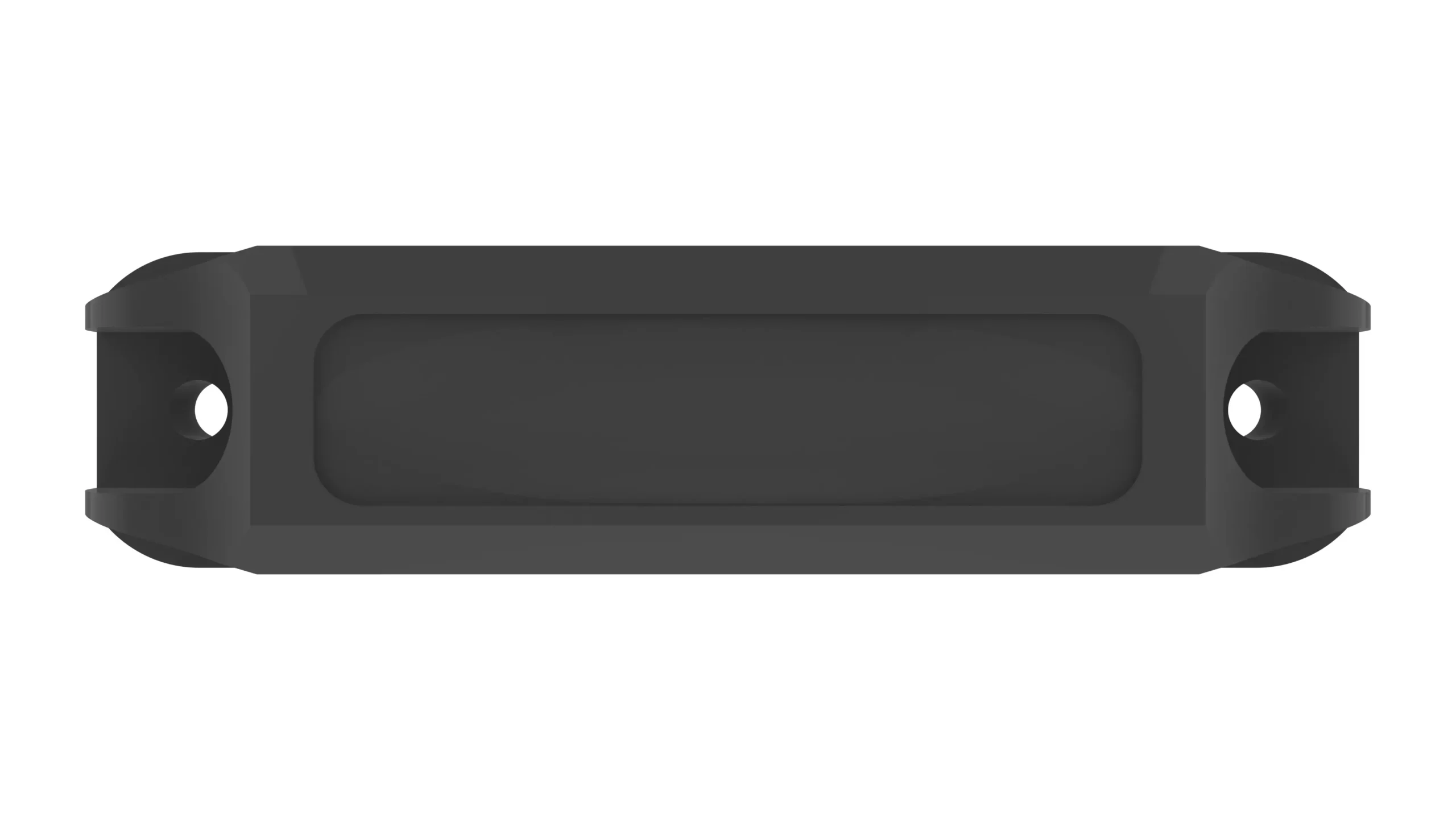
UHF RFID hard tags are called “hard tags” because they are rigid, durable, and much thicker than regular RFID labels or inlays. These tags are manufactured using strong materials such as ABS, polycarbonate, ceramic, steel, polystyrene, and polypropylene, making them suitable for harsh industrial and outdoor environments.
Due to their rugged construction and additional protective features, hard tags are generally more expensive than RFID labels and inlays. Depending on the design, material, and special features, the cost of hard tags can range from below $1 to more than $15 per tag. However, pricing usually becomes lower when purchased in large quantities.
RFID hard tags are available in different shapes, sizes, and weights based on the application requirement. Smaller tags can weigh as little as 0.2 grams, while larger industrial-grade tags can exceed 250 grams. Their size can vary from a small compact tag to larger formats similar to a vehicle license plate.
SOAP Method for RFID Tag Positioning
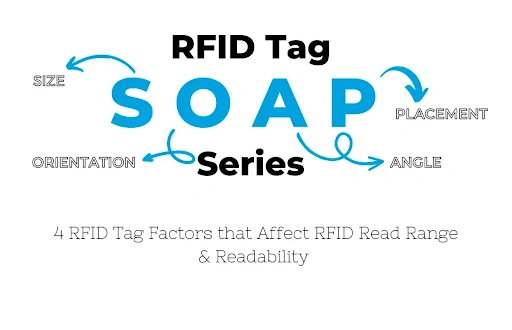
| S – Size | O – Orientation |
| Larger RFID tags generally provide better read range and performance. | Tag direction relative to the antenna affects readability and read accuracy. |
| A – Angle | P – Placement |
| Steep tag angles can reduce read range. Tags should ideally face the antenna directly. | Different mounting locations can produce different RFID read results. Proper testing helps identify the ideal position. |
For a detailed understanding of RFID read range optimization and tag performance, read our blog here: 5 Key Factors Affecting Read Range
RFID Tag Mounting Methods
- Adhesive Mounting: Commonly used for labels, cartons, plastic surfaces, and retail products.
- Screw Mounting: Used for industrial assets, machinery, and metal containers.
- Zip Tie Mounting: Suitable for cables, bins, cylinders, and reusable assets.
- Rivet Mounting: Preferred for rugged outdoor and automotive applications.
- Embedded Tags: RFID tags can also be embedded inside tyres, tools, wood, or industrial equipment for added protection.
Encoding RFID Tags
RFID tags can store much more data than traditional barcodes, making them suitable for asset tracking, inventory management, manufacturing, logistics, healthcare, tolling, and industrial automation. Each RFID tag contains a microchip and antenna, with memory banks such as EPC, TID, USER, and Reserved Memory used for storing product IDs, serial numbers, maintenance records, batch details, passwords, and custom data. RFID tags can be encoded with random identifiers, custom coding schemes like SGTIN or GRAI, or detailed operational records depending on the application. Standards from GS1, RAIN RFID, and ISO help maintain global compatibility and standardized RFID encoding across industries. RFID data can be encoded through RFID printers, desktop encoders, handheld readers, ERP systems, Excel/CSV imports, or cloud-based software platforms for seamless data management and real-time tracking.
For a detailed understanding of RFID encoding methods and memory structure, read our blog here: Guide to Encoding Data in RFID Transponders
Special Features of RFID Tags
Depending on the application, RFID tags may support:
- On-metal compatibility
- High-temperature resistance
- Waterproof and dustproof IP ratings
- Chemical and UV resistance
- High memory options
- Custom printing and encoding
- Rugged industrial housing
- Long-range performance
Real-World Applications of RFID Tags
Retail & Inventory Management
RFID technology helps retailers achieve real-time inventory visibility, faster stock audits, improved shelf availability, and better inventory accuracy. RFID-based inventory management reduces manual stock counting time and improves operational efficiency across retail stores and warehouses.
Supply Chain & Logistics
RFID enables end-to-end shipment tracking across warehouses, distribution centers, transportation hubs, and delivery networks. Businesses use RFID for supply chain visibility, asset tracking, inventory movement monitoring, and reducing losses or misplaced shipments.
Access Control & Attendance
RFID cards and smart ID systems are widely used for employee attendance management, office access control, visitor management, and secure entry systems. RFID-based authentication improves security, automation, and user convenience.
Livestock & Animal Tracking
RFID tags are used in livestock management for animal identification, vaccination records, breeding history, health monitoring, and movement tracking. RFID improves traceability and farm management efficiency.
Contactless Payment Systems
RFID technology powers contactless payment applications such as FASTag, metro cards, smart cards, and automated fare collection systems, enabling quick and secure transactions.
Healthcare & Hospital Management
Hospitals and healthcare facilities use RFID for patient tracking, medical equipment management, pharmaceutical tracking, surgical instrument monitoring, and inventory control to improve patient safety and operational efficiency.
Vehicle Identification & Tracking
RFID systems are widely used for electronic toll collection, parking automation, fleet management, vehicle access control, and vehicle identification systems for faster and automated vehicle movement.
RFID Antennas
RFID antennas are one of the most important components of an RFID system. They transmit RF signals from the RFID reader to RFID tags and also receive data back from the tags for processing. The performance of an RFID system largely depends on selecting the right antenna based on the application environment, read range requirement, tag orientation, mounting area, and coverage zone. RFID antennas are widely used in warehouse automation, inventory management, retail, tolling, logistics, manufacturing, race timing, access control, smart shelves, and vehicle identification systems.
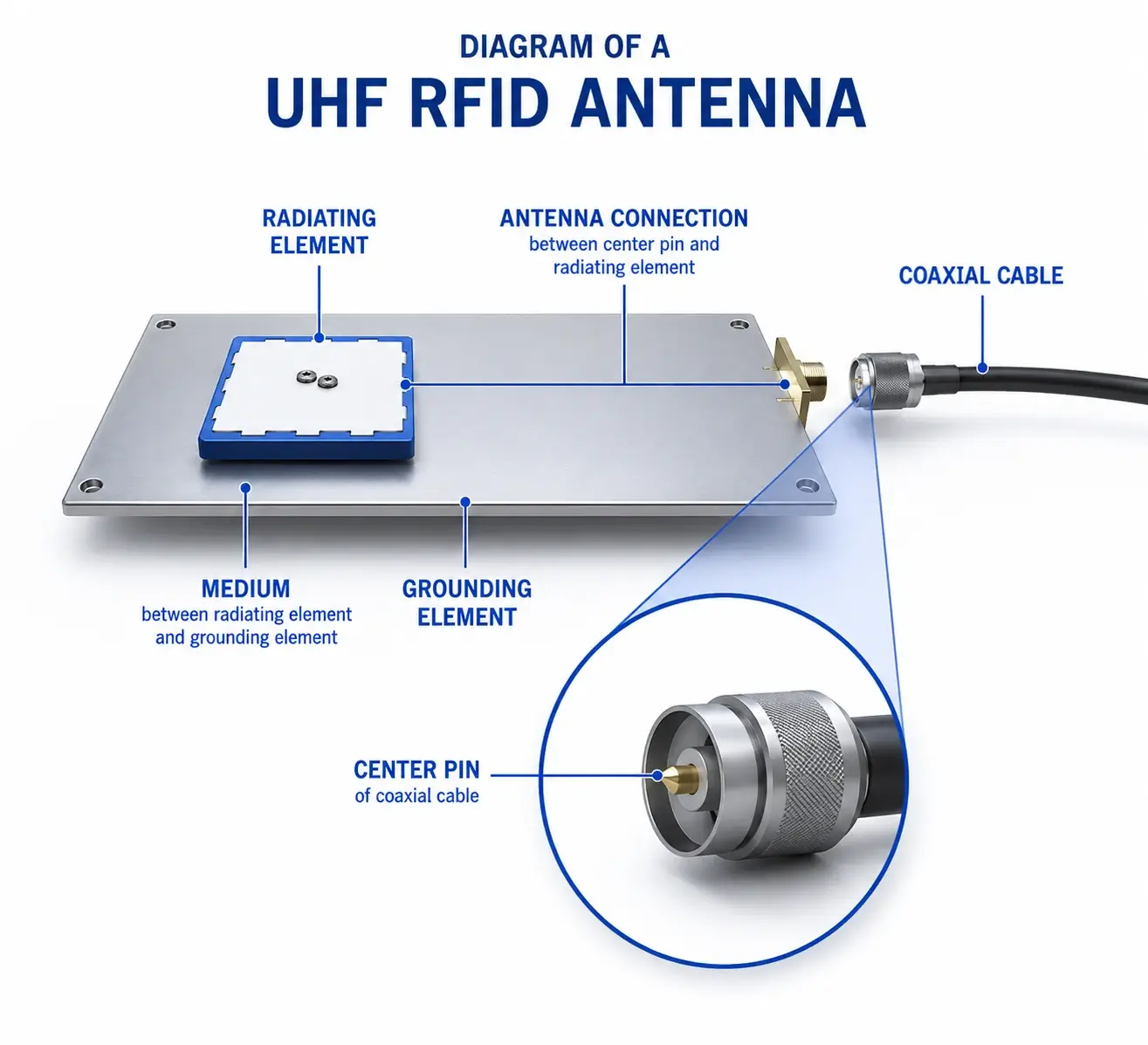
RFID Antenna Types
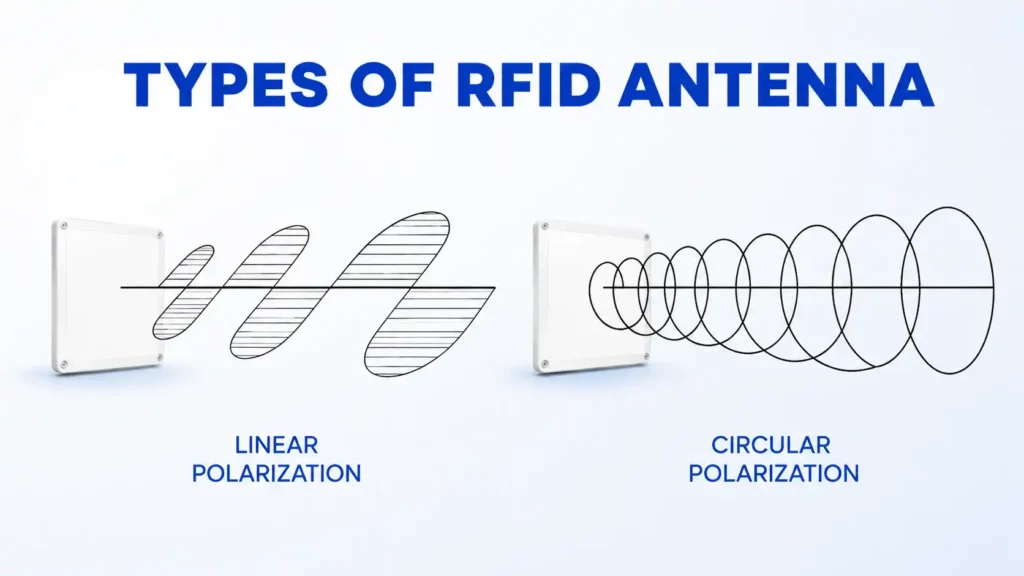
Polarization
Polarization describes the direction of RF wave propagation. The two major types are:
- Linear Polarization
- Circular Polarization
The choice depends on tag orientation and application environment.
Linear Polarized Antennas
Linear polarized RFID antennas transmit RF waves in a single direction, either horizontal or vertical. These antennas provide better read range and stronger signal performance when RFID tags maintain a fixed orientation and height. Linear antennas are commonly used in conveyor systems, rail applications, and fixed-position tracking environments.
Circular Polarized Antennas
Circular polarized antennas transmit RF waves in a rotating pattern, allowing RFID tags to be read from multiple angles and orientations. These antennas are widely used in warehouse portals, dock doors, retail inventory systems, and logistics applications where tag direction may vary. Circular antennas are generally preferred when tag placement is unpredictable.
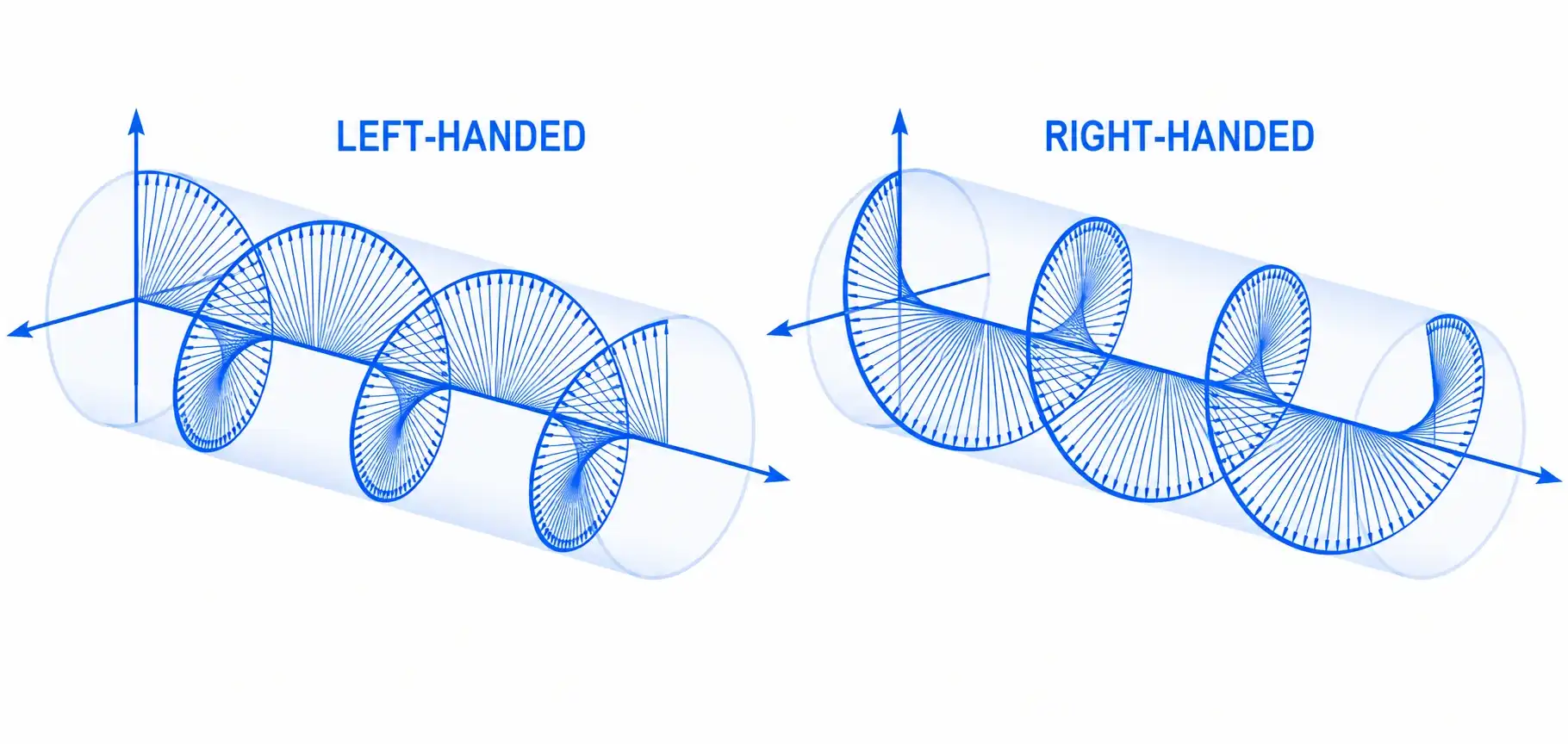
RHCP & LHCP Antennas
Circular polarized antennas are further divided into:
- RHCP (Right-Hand Circular Polarized)
- LHCP (Left-Hand Circular Polarized)
These antenna types are selected based on RF environment requirements to reduce interference and null zones between multiple RFID systems.
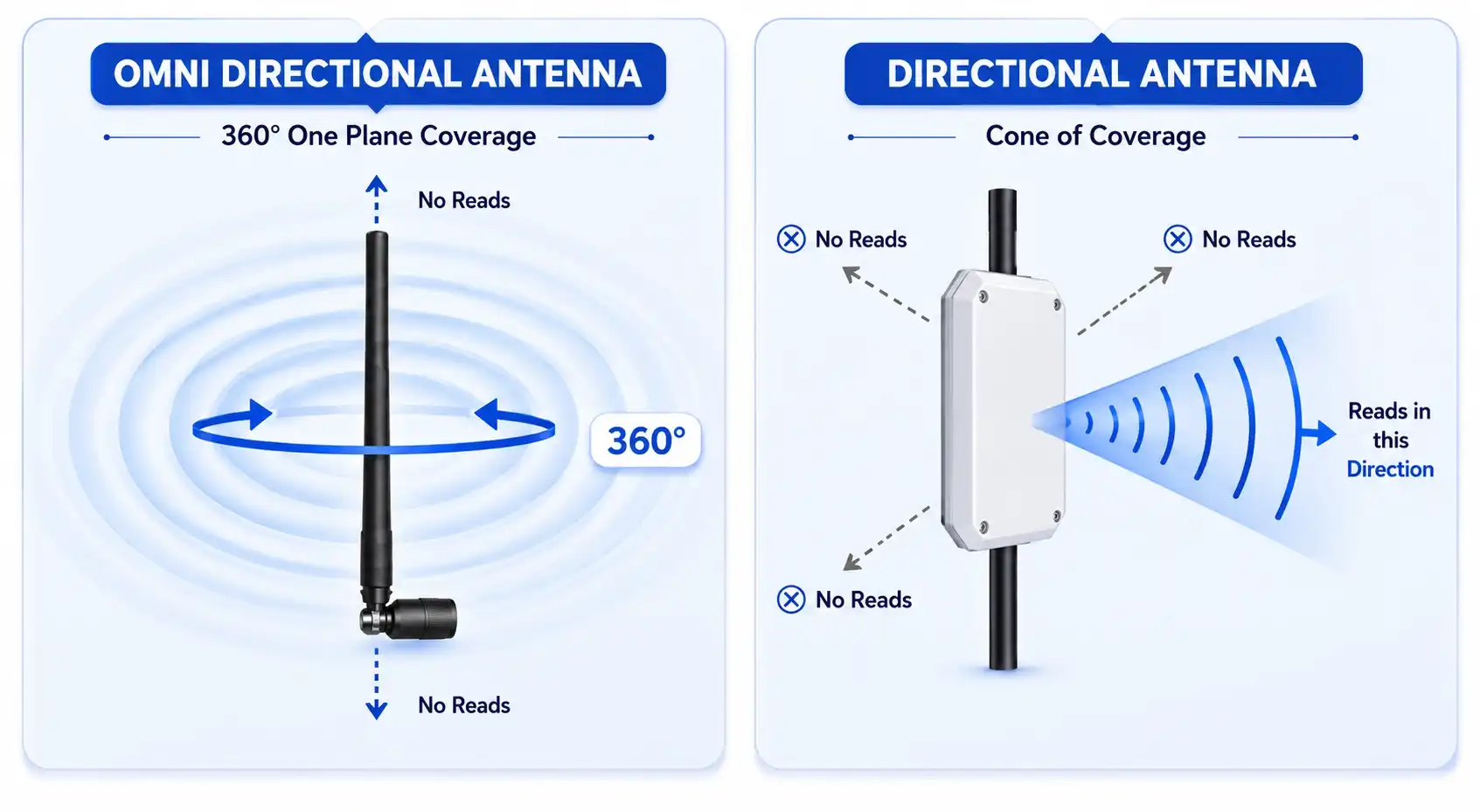
Directional Antennas
Directional RFID antennas focus RF energy in a specific direction to create controlled and long-distance read zones. These antennas are suitable for RFID portals, tolling lanes, dock doors, industrial automation, and vehicle tracking applications.
Omni-Directional Antennas
Omni-directional antennas provide wider RF coverage over a 360-degree plane. These antennas are commonly used in environments where tagged objects move around the antenna from multiple directions.
Near-Field & Far-Field RFID Antennas
Near-Field Antennas
Near-field RFID antennas use magnetic or inductive coupling and are designed for short-range applications such as item-level tagging, smart shelves, document tracking, NFC systems, and access control. These antennas usually support read ranges within a few centimeters to around one foot.
Far-Field Antennas
Far-field antennas use backscatter communication and support long-range RFID reading. These antennas are used in warehouse management, pallet tracking, logistics, tolling, race timing, and vehicle identification applications with read ranges extending up to several meters.
Important RFID Antenna Parameters
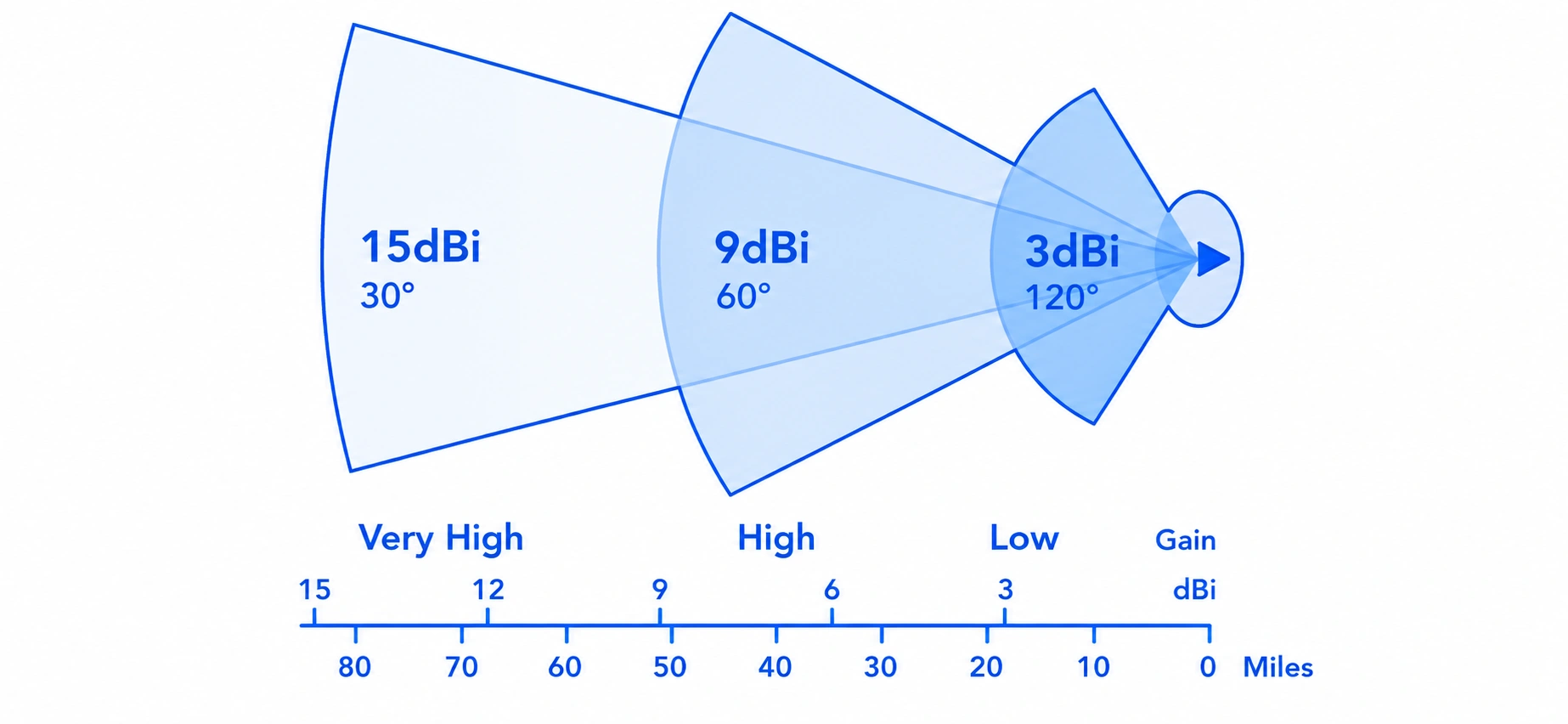
Antenna Gain (dBi)
Antenna gain defines the strength and direction of the RF signal transmitted by the antenna. Higher gain antennas provide longer read ranges but narrower coverage areas, while lower gain antennas offer wider coverage with shorter read distance. Gain is usually measured in dBi.
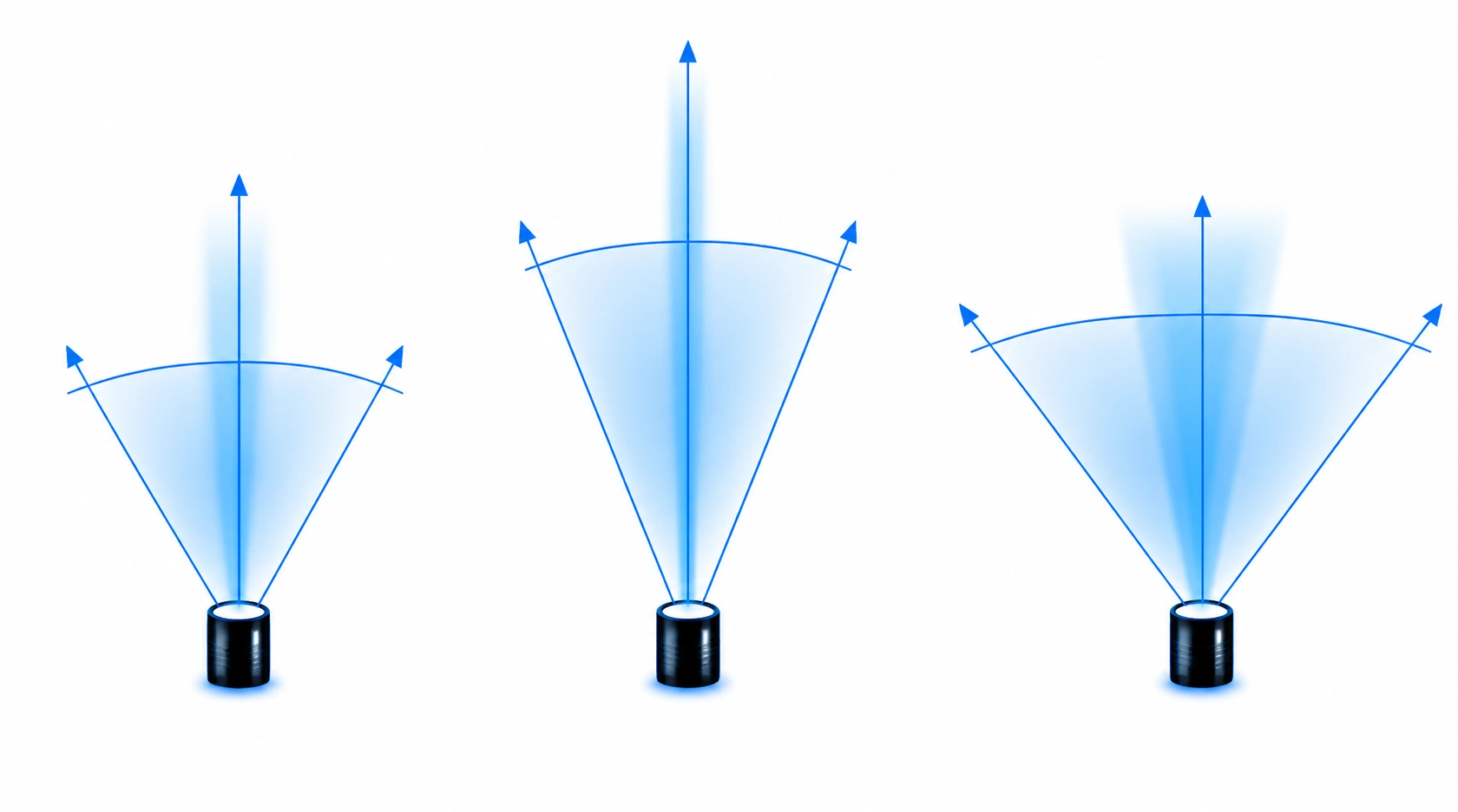
Beamwidth
Beamwidth defines the width and shape of the RF coverage area generated by the antenna. Wide beamwidth antennas cover larger areas, while narrow beamwidth antennas provide focused long-range reading. Beamwidth selection depends on the required RFID read zone.
Frequency Range
RFID antennas are designed for specific frequency regions including:
| Standard | Frequency Range | Region |
| ETSI | 865 – 868 MHz | Europe, India |
| FCC | 902 – 928 MHz | North America |
| Global | 860 – 960 MHz | Multi-region deployments |
All RFID components including tags, readers, and antennas must operate within the same frequency range for proper communication.
VSWR (Voltage Standing Wave Ratio)
VSWR indicates how efficiently RF power is transmitted from the antenna. Lower VSWR values generally indicate better antenna performance and lower signal reflection losses.
Read Range
Read range depends on antenna gain, reader power, cable loss, tag sensitivity, polarization, and environmental conditions. RFID antennas can support short-range or long-range reading depending on the application requirement.
IP Rating & Ruggedness
RFID antennas used in outdoor or industrial environments should support high IP ratings for protection against dust, water, and harsh weather conditions. Industrial RFID antennas commonly support IP65, IP67, or IP68 protection ratings.
Antenna Size & Form Factor
RFID antennas are available in compact, slim, panel, ceiling-mount, integrated, and industrial rugged designs. Antenna size directly impacts read range, coverage area, and installation flexibility. Smaller antennas are generally used for item-level tracking, while larger antennas are preferred for long-range applications.
Choosing the Right RFID Antenna
Selecting the right RFID antenna depends on several factors including:
- Required read range
- Tag orientation
- Indoor or outdoor deployment
- Coverage area
- Mounting space
- Frequency regulations
- Environmental conditions
- Application type
Proper antenna selection plays a major role in achieving accurate RFID performance, stable read rates, reduced stray reads, and efficient RFID system deployment.
RFID Readers
RFID readers are responsible for communicating with RFID tags and collecting data through radio frequency signals. They send RF energy to RFID tags through antennas and receive information back from the tags for processing. RFID readers are widely used in warehouse management, retail inventory tracking, logistics, manufacturing, access control, tolling, healthcare, asset tracking, and industrial automation systems. The overall performance of an RFID system depends heavily on selecting the right RFID reader based on the application, environment, read range, and connectivity requirements.
For a detailed understanding of RFID reader selection and deployment considerations, read our blog here: Key Considerations for Choosing the Best RFID Reader
Types of RFID Readers
- Fixed RFID Readers
- Mobile RFID Readers
Fixed RFID Readers
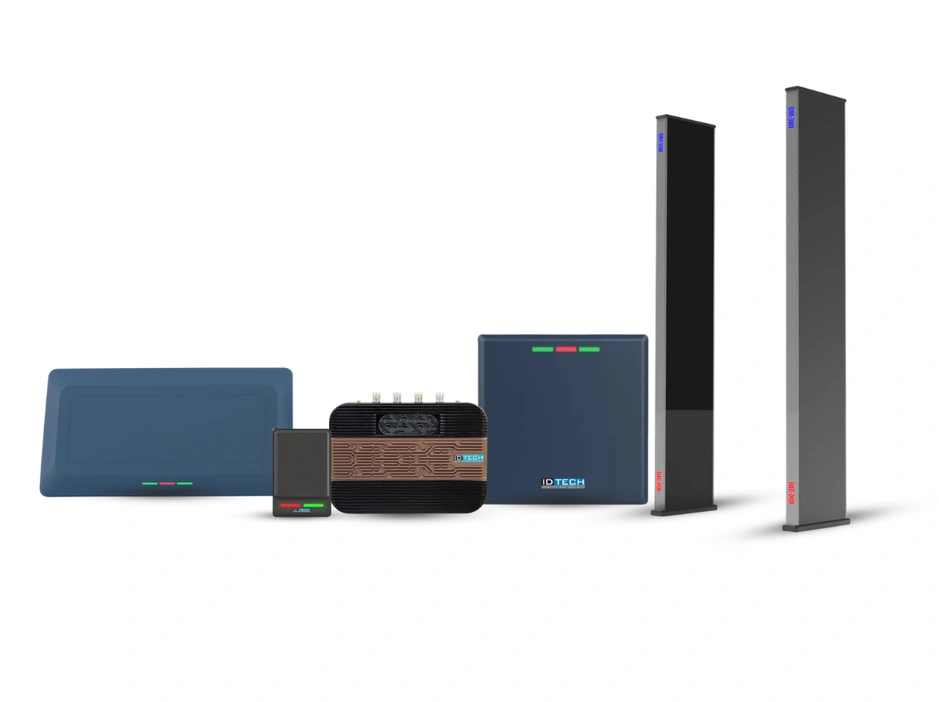
Fixed RFID readers are high-performance readers commonly available in 2-port, 4-port, or 8-port configurations. These readers are designed for stationary RFID applications such as warehouse portals, dock doors, conveyor systems, manufacturing lines, smart shelves, parking systems, and vehicle identification. Fixed readers provide higher transmit power, better receive sensitivity, and support multiple antenna connections for larger RFID coverage areas.
Integrated RFID Readers
Integrated RFID readers combine the RFID reader and antenna into a single compact unit. These readers are suitable for desktop encoding, retail counters, kiosks, file tracking, access control, and smaller RFID read zones where compact installation and cleaner deployment are important.
Mobile RFID Readers:
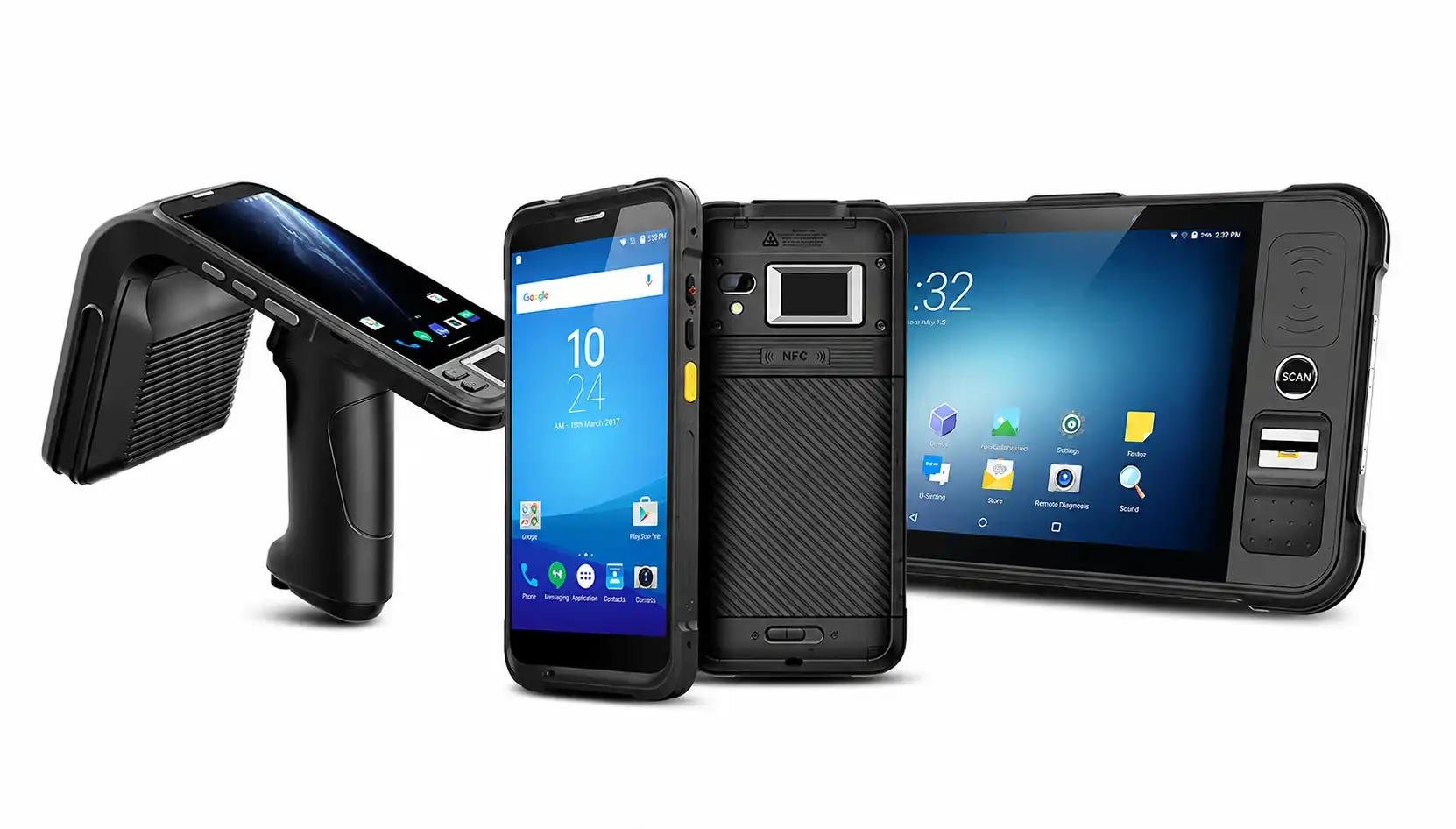
- Handheld RFID Readers
- RFID Sled Readers
Handheld RFID Readers
Handheld RFID readers are portable RFID devices used for inventory management, asset tracking, retail stock audits, warehouse operations, and field inspections. These readers usually include integrated antennas, touch displays, barcode scanners, Wi-Fi, Bluetooth, and Android-based operating systems for mobile RFID applications.
RFID Sled Readers
RFID sled readers are compact mobile RFID readers that connect to smartphones or tablets through Bluetooth or auxiliary ports. These readers convert mobile devices into RFID scanning systems and are commonly used for retail inventory counting, logistics, supply chain operations, and mobile asset tracking.
RFID Reader Power Options
Power Adapter
Most fixed RFID readers are powered through standard AC power adapters connected to nearby electrical outlets.
Power over Ethernet (PoE)
PoE allows RFID readers to receive both power and data through a single Ethernet cable. This simplifies installation and reduces additional cabling costs in warehouse and industrial deployments.
Battery Powered Readers
Mobile and handheld RFID readers are commonly powered through rechargeable batteries, allowing cordless operation for field and warehouse use.
In-Vehicle RFID Readers
Certain RFID readers are specially designed for forklifts, trucks, and industrial vehicles to support pallet tracking, yard management, and vehicle-mounted RFID applications.
RFID Reader Connectivity Options
Wi-Fi
Wi-Fi-enabled RFID readers support wireless communication with cloud platforms, ERP systems, warehouse software, and network applications.
Bluetooth
Bluetooth connectivity is mainly used in handheld readers and RFID sleds for communication with smartphones, tablets, and mobile devices.
LAN / Ethernet
LAN connectivity allows RFID readers to connect directly to local networks for stable and high-speed communication.
Serial & USB Connectivity
RFID readers may support serial ports, USB interfaces, and auxiliary ports for direct communication with computers, industrial systems, and embedded devices.
RFID Reader Antenna Ports
RFID readers are available with different antenna port configurations such as 2-port, 4-port, and 8-port readers. The number of antenna ports determines the coverage area and number of RFID read zones supported within the application. Larger RFID deployments may also use multiplexers or antenna hubs to connect additional antennas to a single reader.
GPIO Support in RFID Readers
Many industrial RFID readers support GPIO (General Purpose Input/Output) functionality for integration with external devices such as motion sensors, light stacks, alarms, gates, conveyors, and annunciators. GPIO integration helps automate industrial RFID workflows and event-based operations.
Important RFID Reader Parameters
When selecting an RFID reader, important technical specifications include:
- Supported Frequency Range (ETSI / FCC / Global)
- Reader Output Power
- Receive Sensitivity
- Read Rate & Tag Throughput
- Number of Antenna Ports
- Connectivity Options
- GPIO Support
- Operating System & API Support
- IP Rating & Ruggedness
- Barcode & GPS Support
- Power Options
- Onboard Processing Capability
- RFID Protocol Support (EPC Gen2 / ISO 18000-6C)
Choosing the Right RFID Reader
Selecting the right RFID reader depends on several factors including application type, read range, environment, mobility requirements, connectivity, antenna coverage, and system integration needs. Proper RFID reader selection helps improve read accuracy, inventory visibility, automation efficiency, and overall RFID system performance.
RFID Technology Trends 2026: What Businesses Need to Know
RFID technology is evolving rapidly, and businesses are adopting smarter and more connected solutions every year.
Digital Product Passport (DPP)
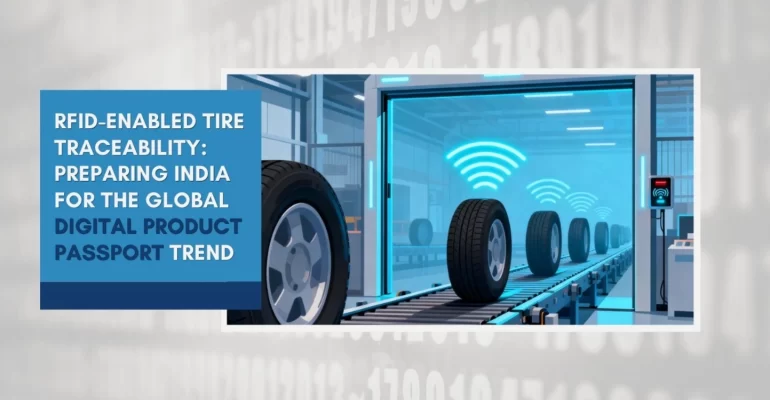
Digital Product Passport (DPP) is becoming a major trend in the RFID industry, especially across Europe with new sustainability and circular economy regulations. DPP creates a digital identity for products by storing information such as product origin, material composition, manufacturing details, repair history, recyclability, warranty, and environmental impact throughout the product lifecycle.
RAIN RFID technology is expected to play a key role in enabling Digital Product Passports by providing real-time product tracking, item-level traceability, inventory visibility, and automated data capture across the supply chain. RFID-enabled DPP solutions help businesses improve supply chain transparency, sustainability compliance, product authentication, inventory management, and lifecycle tracking.
Industries such as retail, fashion, manufacturing, automotive, electronics, and logistics are increasingly adopting RFID-based Digital Product Passport solutions to support sustainability initiatives, improve operational efficiency, and meet upcoming regulatory requirements.
RFID in Smartphones
The integration of UHF/RAIN RFID technology into smartphones is expected to transform both enterprise and consumer applications. Enterprise mobile devices already support built-in RFID functionality for inventory management, asset tracking, warehouse operations, and retail stock audits. With the growing adoption of Digital Product Passport (DPP) regulations and global transparency initiatives, future smartphones may support wider RAIN RFID capabilities beyond NFC.
Embedding UHF RFID into smartphones can enable real-time product authentication, Digital Product Passport access, supply chain traceability, self-checkout, inventory visibility, and consumer engagement directly from mobile devices. This shift is expected to accelerate RFID adoption across retail, logistics, manufacturing, healthcare, and sustainability-driven industries.
Sustainable Supply Chains
RFID technology helps businesses improve inventory accuracy, reduce operational waste, and optimize transportation and supply chain efficiency. Real-time visibility through RFID enables better stock management, reduced overproduction, fewer inventory losses, and improved resource utilization across warehouses, retail stores, and logistics networks.
RFID also plays a major role in supporting circular economy initiatives by enabling product traceability, reuse, repair, recycling, and lifecycle tracking. With technologies such as Digital Product Passports (DPP), RFID helps companies monitor products from manufacturing to end-of-life disposal, improving sustainability compliance, reverse logistics, material recovery, and responsible recycling practices.
Ready to Upgrade Your Operations?
Ready to upgrade your operations with intelligent RFID and ID technology?
ID Tech delivers reliable tracking, secure identification, and automation systems tailored to your business needs. Contact us today or visit our website to take the first step toward smarter, future-ready operations.
Also, make sure to follow us on LinkedIn to stay updated with our latest developments, innovations, and case studies.
Frequently Asked Questions:
1. Is RFID better than barcodes?
RFID is generally faster and more efficient than barcodes because it does not require line of sight and can scan multiple items simultaneously. However, barcodes are still more cost-effective for simple applications.
2. Can RFID be used for inventory management?
Yes. RFID is widely used for inventory management because it provides real-time visibility, faster stock counting, and higher inventory accuracy.
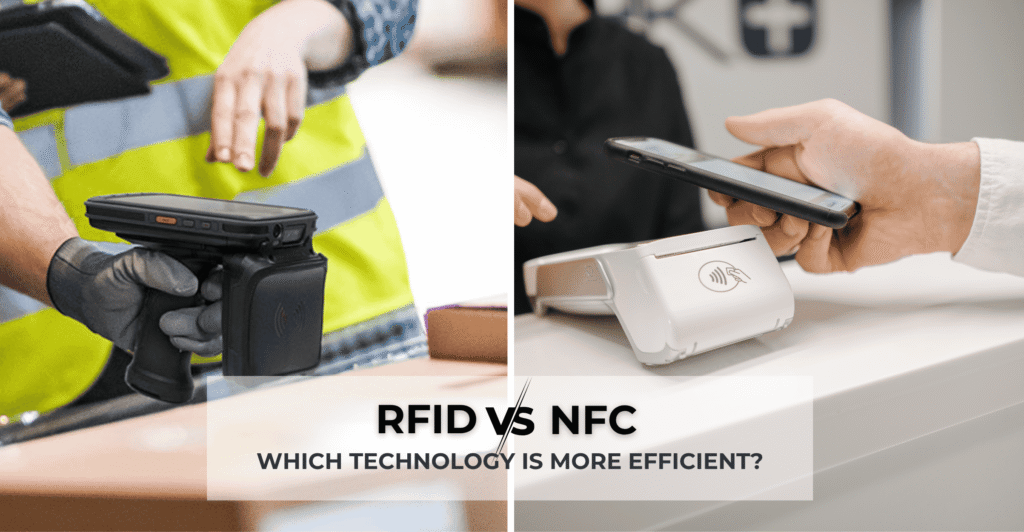
3. How are RFID tags different from NFC?
NFC is a subset of High Frequency RFID technology designed for very short-range communication, mainly used in smartphones and contactless payments.
4. How much do RFID tags cost?
RFID tag costs vary depending on the type, frequency, and application. Passive RFID tags are usually inexpensive, while active RFID tags cost more because they contain batteries.
5. Can RFID replace barcodes?
In many applications, RFID can replace barcodes because it offers automation and bulk scanning capabilities. However, barcodes remain popular due to their lower cost.
6. Are RFID tags secure?
Yes. RFID systems can include encryption, password protection, and access controls for enhanced security.
7. Why Should Businesses Consider Adopting RFID Technology Now?
Businesses should consider adopting RFID now because the technology has become more affordable, accurate, and easier to integrate with modern ERP, WMS, and IoT platforms. With increasing pressure to improve inventory accuracy, reduce labor costs, and gain real-time operational visibility, RFID provides a scalable solution that helps organizations automate processes, minimize errors, and make faster, data-driven decisions.
Contact Us
Looking to implement RFID in your business? Contact ID Tech to discuss your requirements and discover the right RFID readers, tags, antennas, and end-to-end solutions for your application. Our team can help you design and deploy a solution tailored to your operational needs.