India is one of the largest jewellery markets in the world. As of January 2026, the Indian gems and jewellery market was valued at around ₹7.31 lakh crore (US$85 billion) and is projected to reach US$130 billion by 2030. The industry also employs nearly five million people.
For an industry dealing with thousands of small, high-value items every day, inventory accuracy is not just an operational requirement. It is directly connected to security, accountability and loss prevention.
A jewellery showroom may contain thousands of rings, chains, earrings, pendants, bracelets and diamond pieces. Throughout the day, these items move between vaults, trays, display counters, billing counters and customers.
The challenge is quite simple: how do you know exactly what is in the store, what has moved and what is missing, without physically counting and scanning every individual piece?
This is where RFID jewellery inventory management can make a practical difference. Understanding how jewellery retailers in India use RFID for inventory security starts with understanding that RFID is not simply a faster barcode, it changes how inventory can be identified, verified and reconciled.
How RFID Jewellery Inventory Management Works
In a typical RFID jewellery tracking system, every jewellery item is assigned an RFID tag containing a unique identification number.
The unique Electronic Product Code (EPC) can then be associated in the inventory software or ERP with information such as SKU, design code, gross weight, net gold weight, purity, stone details, certification, price, location or stock status.
GS1 defines the EPC as a means of assigning unique identifiers to physical objects, while its EPC Tag Data Standard defines how EPC information can be encoded on RAIN RFID tags.
In a typical RFID jewellery tracking system, every jewellery item is assigned an RFID tag containing a unique identification number.
The unique Electronic Product Code (EPC) can then be associated in the inventory software or ERP with information such as SKU, design code, gross weight, net gold weight, purity, stone details, certification, price, location or stock status.
GS1 defines the EPC as a means of assigning unique identifiers to physical objects, while its EPC Tag Data Standard defines how EPC information can be encoded on RAIN RFID tags.
Why UHF RFID is commonly used for jewellery inventory
For bulk inventory applications, passive UHF RFID or RAIN RFID is particularly useful because multiple tags can be identified rapidly without requiring direct line-of-sight with every item.
GS1’s EPC Gen2 standard defines passive UHF RFID communication in the UHF spectrum. UHF RFID is widely used for fast asset identification, inventory and tracking applications.
This is an important difference from barcode scanning.
With a barcode, an operator generally needs to locate the label, orient the scanner and scan items individually. With RFID, the operator can move an RFID handheld reader across a tray or display counter and identify multiple tags within the configured read zone.
That makes repeated stock verification much more practical.
Jewellery-specific RFID tags
Jewellery is also one of the more challenging environments for RFID.
Gold, silver, platinum and other metals can affect RF behaviour, while tags are often positioned close together inside dense trays. The tag therefore has to be selected according to the jewellery type, attachment method, orientation, required read distance and actual showroom environment.
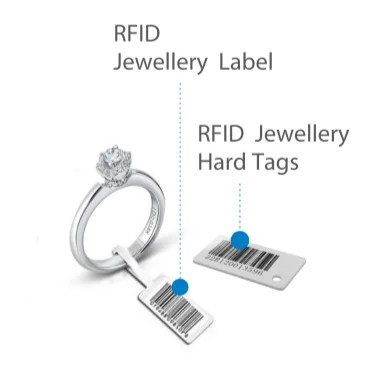
Common form factors include jewellery soft labels, loop or tail-style labels and reusable hard tags. ID Tech’s own jewellery tag portfolio, for example, includes passive UHF hard tags and soft labels designed for item-level jewellery tracking.
The important point is that the smallest tag or the tag with the longest advertised read range is not automatically the best tag.
For jewellery, the correct tag is the one that provides repeatable performance on the actual product without damaging, scratching or interfering with the presentation of the item.
Why RFID Jewellery Tracking Systems Matter for Inventory Security
The first benefit people normally associate with RFID is faster stock counting. For jewellery retailers, however, the more valuable benefit is knowing exactly which item has not been accounted for.
Suppose the system expects 1,500 tagged items at closing time but detects 1,499.
A conventional count tells you that one piece is missing. An item-level RFID jewellery stock verification process can identify the EPC of the missing piece and therefore determine exactly which SKU needs to be investigated.
The team can then check whether the item was sold, transferred, sent for repair, moved to another tray, left at a customer interaction counter or genuinely unaccounted for.
That makes RFID useful as an additional layer of jewellery loss prevention.
It is important to make one distinction here: RFID does not replace CCTV, access control, vault security or trained staff. Instead, it adds a layer of inventory intelligence that can help discrepancies become visible much earlier.
Opening and closing stock verification
Daily opening and closing audits are one of the strongest use cases for RFID in jewellery retail.
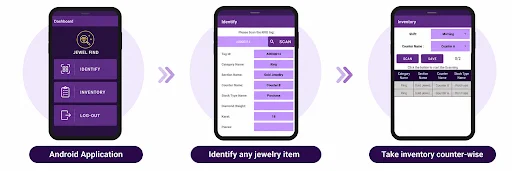
Instead of handling and scanning every piece individually, staff can use a UHF RFID handheld to move through counters and trays while the application continuously compares detected EPCs against expected inventory.
Modern RFID handhelds are designed for high-speed multi-tag identification, making this kind of repeated stock verification considerably more practical than individual barcode scanning.`
Search for a missing jewellery item
RFID handhelds can also be used as search devices.
If a ring has been placed in the wrong tray or a pendant has accidentally been moved to another counter, the operator can select its EPC in the application and use the handheld to narrow down its location based on the detected RFID signal.
Instead of manually opening and checking multiple trays, the staff member has a much faster way to locate the item.
Counter, tray and vault movement
RFID can also create visibility around how inventory moves between storage and customer-facing areas.
Depending on the system architecture, jewellery can be recorded when it moves from the vault to a counter, between trays, to billing, for repair or back into secure storage.
For retailers with several counters or branches, this creates a much more useful digital audit trail than simply knowing the total number of pieces in the store.
RFID Jewellery Loss Prevention: Can RFID Prevent Theft?
RFID should not be positioned as a standalone anti-theft technology.
What it can do extremely well is improve detection, verification and accountability.
For example, if an item is removed from a tray but is not subsequently returned, sold or transferred in the software, the discrepancy can be identified during the next stock verification.
RFID can also be integrated with controlled exit points or RFID portals where the application requires exit monitoring. The exact architecture needs to be carefully designed so that tags outside the intended zone do not generate unnecessary reads.
Another useful application is tag verification at billing. The RFID identity associated with the item can be checked against the expected product record before completing the transaction, adding another verification point to the sales process.
RFID therefore contributes to RFID jewellery loss prevention by making stock movement more visible rather than attempting to replace the showroom’s physical security infrastructure.
Key Benefits of RFID Jewellery Management for Indian Retailers
Faster inventory verification
RFID makes it possible to identify multiple tagged items during the same inventory operation rather than individually locating and scanning every barcode.
For retailers carrying thousands of SKUs, the time saving becomes increasingly significant as inventory grows.
Better inventory accuracy
RFID provides unique item-level identification.
Instead of simply knowing that there should be 100 rings in a counter, the system can know which 100 rings are expected and which EPCs were actually detected.
Faster identification of discrepancies
This is where RFID becomes particularly valuable for high-value inventory.
Missing items can be flagged against the expected inventory immediately after a stock check rather than being discovered much later during reconciliation.
Better use of sales staff
Jewellery is a high-touch retail business.
Reducing the time employees spend on repetitive stock counting gives them more time for customer service, product presentation and sales.
Inter-store stock movement
RFID can also support stock transfers between branches, warehouses, exhibitions and other locations.
Items can be verified during dispatch and again at receipt, creating a digital record of what was expected, what was sent and what was actually received.
ERP and billing integration
The RFID layer does not need to operate independently from the retailer’s existing systems.
Middleware or APIs can connect RFID events with jewellery management software, POS platforms, billing applications, Tally-based workflows or customised ERP systems.
The objective should be to add automated data capture to the existing business process rather than create another isolated inventory database.
Components of an RFID Jewellery Stock Management System
A jewellery RFID deployment is not just a tag and a reader.
A reliable solution normally combines the tag, reader, software and integration layer.
1. Jewellery-grade RFID tags
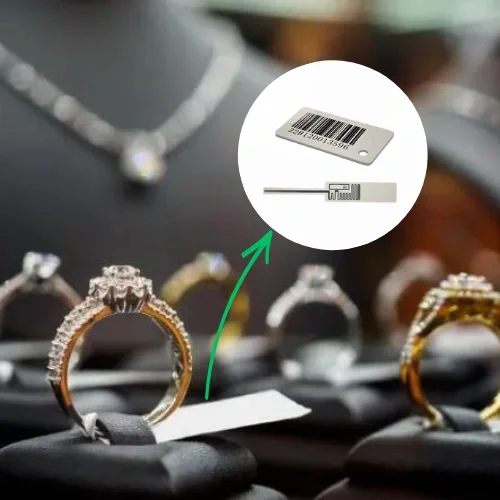
The RFID tag is one of the most important components of the system.
Tags need to be tested with actual rings, chains, necklaces, bracelets and other jewellery because metals, product geometry and orientation influence RF performance.
Depending on the workflow, retailers may choose disposable soft labels or reusable hard tags. ID Tech’s UHF jewellery tags are available in hard-tag and soft-label formats for item-level retail and inventory applications.
2. UHF RFID handheld readers
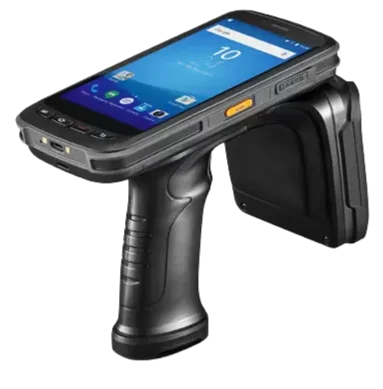
For most jewellery stores, the handheld reader becomes the primary tool for daily stock verification.
The employee can walk from counter to counter while the application identifies tagged items and reconciles them with expected inventory.
Modern handheld platforms can also combine UHF RFID with barcode scanning, Android applications and wireless connectivity, allowing the same device to support multiple retail workflows.
3. Desktop readers and smart pads
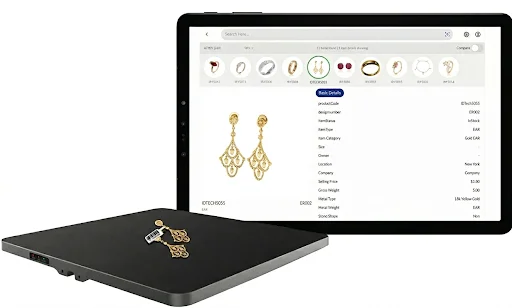
A controlled desktop RFID read zone can be used at billing, tagging, verification or transfer counters.
Instead of reading an entire showroom, the objective here is the opposite: create a small, predictable RF zone that identifies only the jewellery intentionally placed on the pad.
ID Tech’s IDT-108 desktop reader, for example, supports EPC Class 1 Gen2/ISO 18000-6C and multi-tag inventory and is designed for applications including retail POS, inventory and jewellery tracking.
4. Fixed readers, portals and smart counters
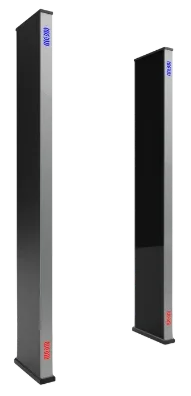
Where automated movement detection is required, fixed RFID readers and antennas can be installed at specific transition points.
The key word here is controlled.
A reader operating at maximum power is not necessarily a better RFID system. Antenna placement, reader power, tag orientation, reflections from metal and glass, and neighbouring read zones all need to be considered during implementation.
5. RFID middleware and jewellery management software
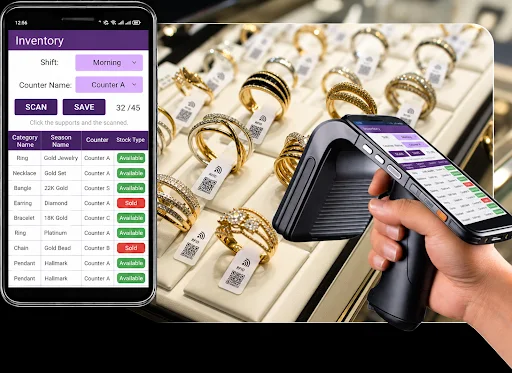
RFID hardware produces tag reads. Those reads only become useful when software converts them into business events.
The middleware filters duplicate reads, associates EPCs with inventory records and communicates relevant events to the ERP, POS or jewellery management application.
The final dashboard can then show information such as available stock, missing stock, transferred items, repair status, location and inventory reconciliation reports.
ID Tech’s jewellery tracking solution similarly combines tagging, handheld identification, inventory visibility, smart displays and reporting rather than treating RFID as a standalone hardware deployment.
RFID vs Barcode for Jewellery Inventory
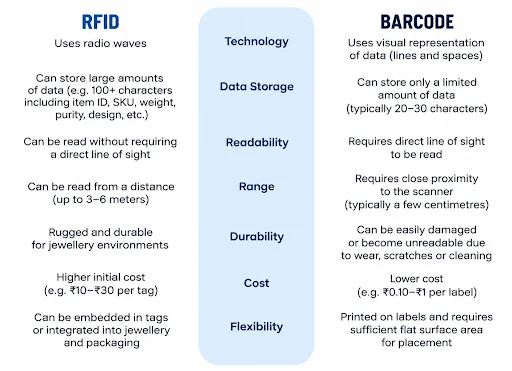
This does not need to be an RFID-versus-barcode argument.
Barcodes are inexpensive, widely adopted and perfectly suitable for many jewellery operations.
The difference appears when a retailer needs to verify hundreds or thousands of individually identified items repeatedly.
Barcode scanning generally requires line-of-sight and individual scans. Passive UHF RFID can capture unique identifiers without direct line-of-sight and at much higher rates. GS1 notes that RAIN RFID can capture unique identifiers at very high rates and at distances well beyond those normally associated with HF technologies.
For jewellery retailers, this makes RFID particularly useful for frequent bulk inventory verification, while barcode or QR codes can continue to support other processes.
In many implementations, the most practical architecture is therefore not RFID instead of barcode, but RFID integrated into the retailer’s existing identification and ERP environment.
Looking to implement RFID jewellery tracking?
Every jewellery environment is different. Tag type, jewellery material, tray design, counter construction, inventory density and workflow all affect RFID performance.
ID Tech offers RFID jewellery tags, handheld readers, desktop readers and jewellery tracking software for end-to-end inventory visibility.
Talk to our RFID experts to evaluate your showroom workflow or book an RFID jewellery tracking demo using your actual jewellery and trays before planning a full-scale deployment.
Frequently Asked Questions
1. What is RFID and how does it work in the jewellery industry?
RFID (Radio Frequency Identification) uses RFID tags and readers to identify and track jewellery items without direct line-of-sight scanning. ID Tech’s RFID Jewellery Tracking Solution helps retailers automate inventory management, stock audits and jewellery tracking.
2. What are the benefits of using RFID technology for managing jewellery inventory?
RFID helps jewellery retailers reduce manual counting, improve inventory accuracy, identify missing items and perform faster stock audits. It also provides better visibility of jewellery movement across showrooms and storage areas.
3. Can ID Tech RFID tags be used on all types of jewellery?
Yes. RFID Jewellery Tags are available for different jewellery types, including gold, diamond and silver jewellery. The appropriate tag and attachment method depend on the item’s size, material and design.
4. How do I implement ID Tech RFID in my jewellery business?
Start by selecting suitable RFID Jewellery Tags, handheld or fixed readers and inventory tracking software. The solution can be configured according to your showroom layout, inventory size and existing billing or ERP system.
5. What are the advantages of using RFID technology in jewellery businesses?
RFID helps retailers improve stock accuracy, reduce inventory losses, simplify daily audits and improve customer service. Solutions such as the IDT Smart Interactive Tray also help track jewellery items during customer interactions at sales counters.
6. Where can jewellers deploy ID Tech RFID Jewellery Tracking Solutions?
RFID can be deployed at jewellery display counters, stockrooms, vaults, billing counters, warehouses and multiple showroom locations for inventory verification and item-level jewellery tracking.
7. How does ID Tech’s RFID Jewellery Tracking Solution integrate with specialized jewellery software?
The RFID solution can integrate with compatible jewellery ERP, POS and billing software to synchronize inventory records, stock movement and sales data through supported integration methods.
8. Can ID Tech manage inventory tracking across multiple jewellery showrooms?
Yes. The RFID Jewellery Tracking Solution supports centralized inventory visibility, stock verification and inter-store jewellery movement tracking across multiple showroom locations.