A product rarely moves directly from manufacturing to the customer.
In between, it may go through production, packing, a warehouse, a distribution centre, transportation, another warehouse and finally a retail or customer location. At every stage, there is inventory coming in, going out or moving internally.
And this is where things can get difficult.
You may know that a pallet was dispatched from the plant, but has it reached the warehouse? Was the complete shipment received? Is it still in storage or has it already moved to staging? Was the right pallet loaded onto the vehicle?
The more locations and movements involved, the harder it becomes to maintain accurate supply chain visibility.
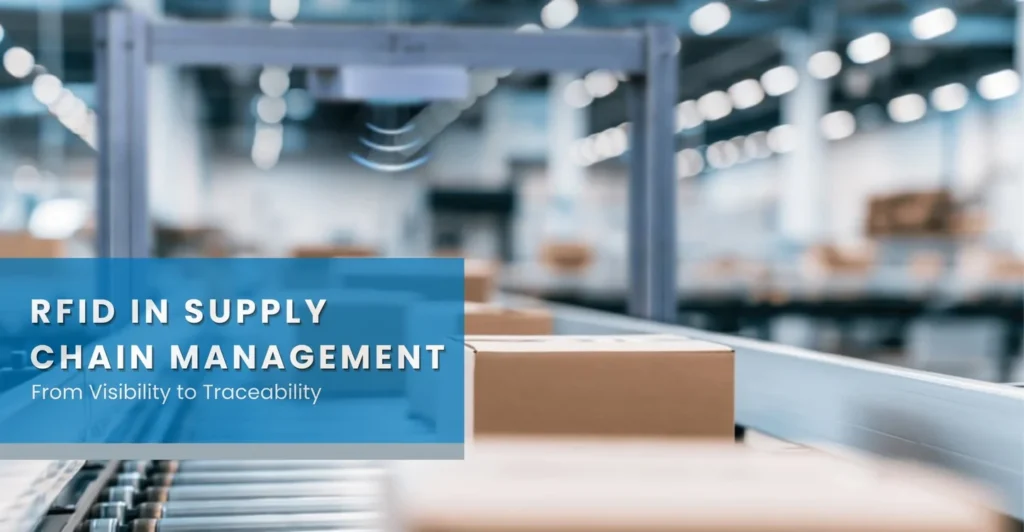
RFID in Supply Chain Management helps connect these physical movements with digital records. Products, cartons, pallets or returnable assets are given unique RFID identities, and readers capture those identities at important points across the supply chain.
So instead of depending on someone to scan every item manually, inventory can be identified automatically as it moves.
More importantly, the same RFID identity can be captured again and again at different locations. This is what takes RFID beyond inventory visibility and towards actual supply chain traceability.
How Does RFID Actually Work in a Supply Chain?
Let us take a normal warehouse operation.
A manufacturer has finished producing a batch of products. The products or cartons are RFID tagged, and each tag is encoded with a unique EPC, or Electronic Product Code.
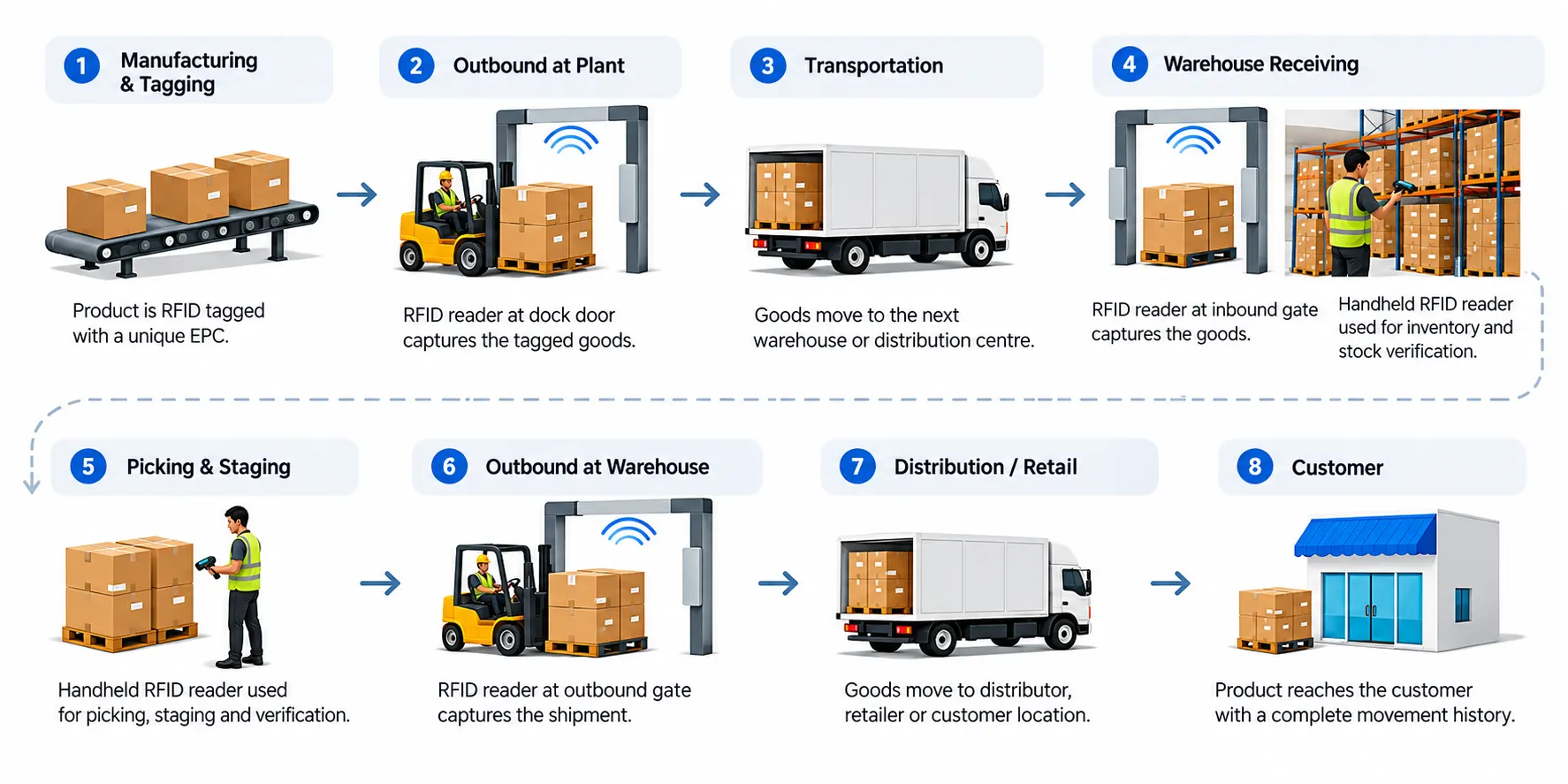
The cartons are packed and moved towards dispatch.
At the outbound dock door, a fixed RFID reader and antennas create a defined read zone. As the tagged goods move through this area, the RFID reader captures their EPCs.
When the shipment reaches the next warehouse, another RFID read point can identify the same tags at the inbound dock door.
Now the warehouse knows what has physically arrived.
Inside the facility, an operator may use an RFID handheld reader for cycle counting, stock verification or locating a particular tagged item.
When the order is eventually dispatched, the RFID tags can be captured again at the outbound read point.
The technology behind this is quite straightforward.
The RFID tag identifies the object. The reader and antenna capture that identity. The read point tells the system where the event happened. And the software connects that RFID event with the WMS, ERP or another business application.
That is essentially how RFID follows physical inventory through the supply chain.
RFID Tags for Supply Chain Management
The RFID tag is where the identification starts.
For warehouse and logistics applications, passive UHF RFID is commonly used because the tag does not need its own battery and can be identified automatically from a distance.
But choosing an RFID tag is not simply about selecting UHF and putting the same label on everything.
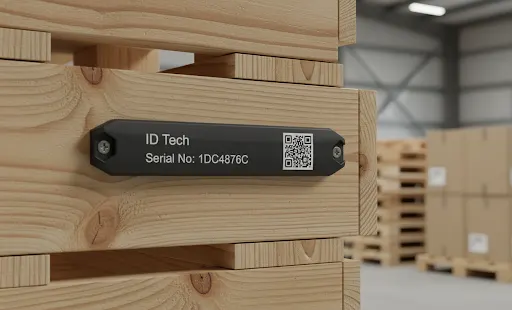
Think about the difference between a cardboard carton and a metal stillage. The same tag that performs well on the carton may not work properly when placed directly on metal.
A normal UHF RFID label may be suitable for cartons and packaging. Metal pallets, containers or industrial equipment generally require on-metal RFID tags. Reusable assets may need rugged hard tags that can handle repeated movement and outdoor conditions.
Cold-chain environments bring another set of considerations, including temperature, moisture and the material being tagged.
So before selecting the tag, we normally need to understand the application first.
What are we tagging? Where is the tag going to be placed? What is the operating environment? What read range is required? And where will the RFID read actually happen?
These factors usually tell us much more than simply looking at a tag’s datasheet.
ID Tech offers different RFID tags, labels and industrial RFID products for these types of applications.
Why Unique Identification Matters
One important part of RFID is serialization.
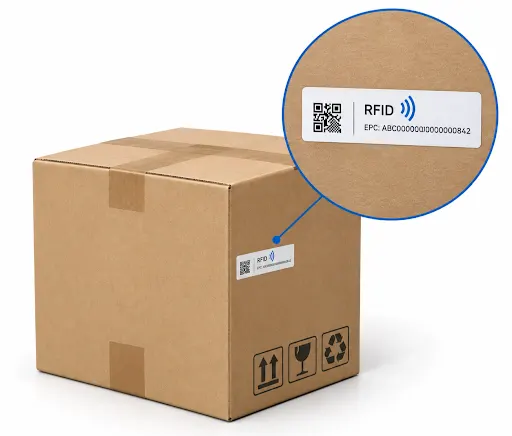
Suppose a warehouse has 500 cartons containing exactly the same product.
The SKU tells us what product is inside those cartons. But if each carton has its own unique EPC, the system can distinguish one carton from another.
Now imagine one of those cartons moving through several locations.
Its EPC is captured when it leaves the manufacturing plant. The same EPC is captured when it enters the warehouse. It is identified again during staging and once more at dispatch.
The RFID tag itself is not necessarily storing this entire journey.
It is providing the unique identity that allows the backend system to connect all these events.
And this is where RFID starts becoming particularly useful for traceability.
RFID Supply Chain Visibility: Knowing What Is Where
Most businesses already have inventory records. The bigger challenge is keeping those records aligned with what is actually happening on the warehouse floor.
A WMS might say a pallet is available in the warehouse. But if someone needs that pallet right now, can they actually find it?
RFID helps close this gap.
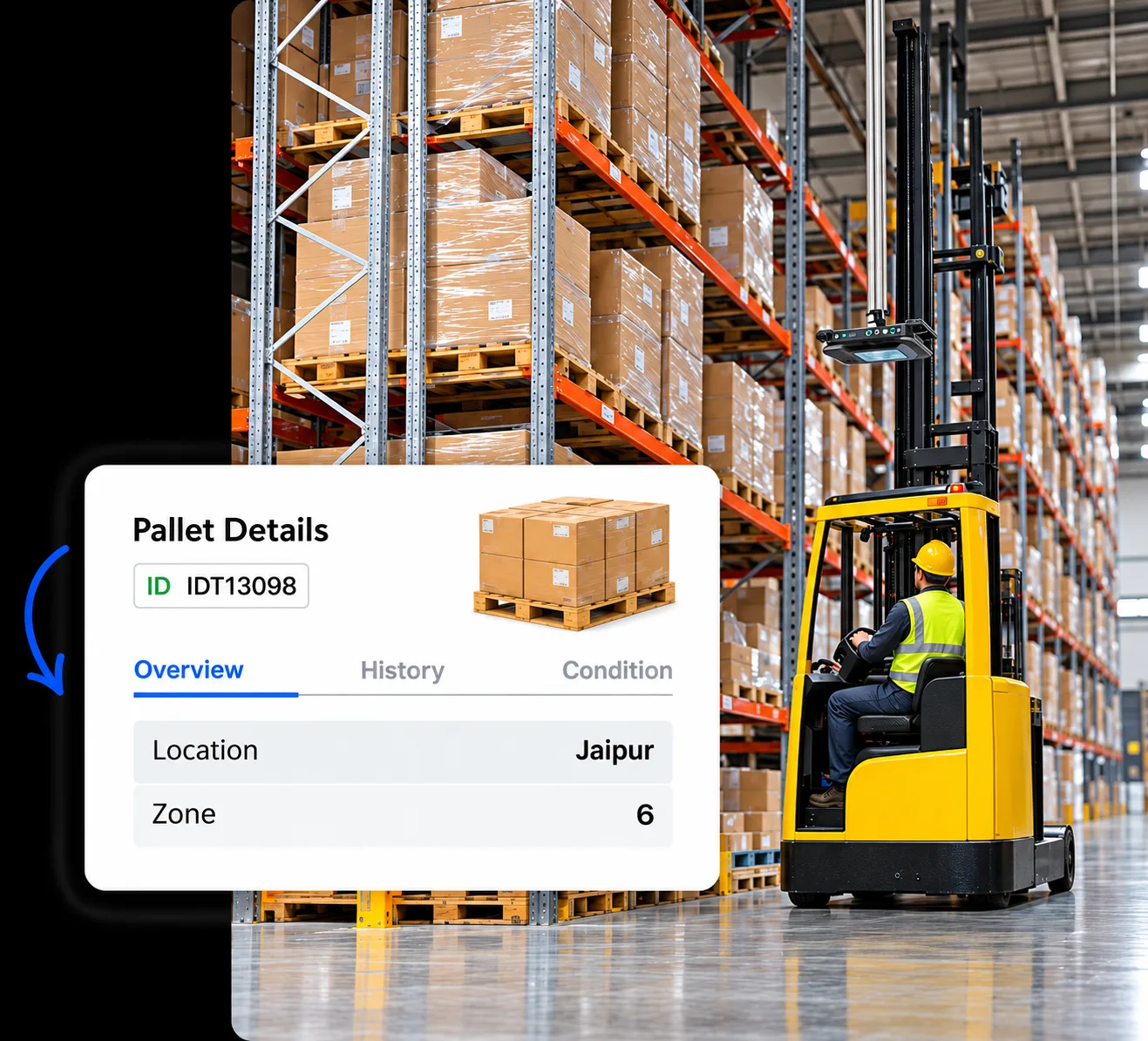
Fixed readers can automatically capture inventory at important movement points, while handheld RFID readers can be used for cycle counts, stock verification and item search.
Suppose a pallet was captured at the inbound dock but was never captured at the expected next read point.
That information alone gives the warehouse team somewhere to start looking.
A Practical Example: RFID Across a Tyre’s Lifecycle
A tyre is a good example of this because its lifecycle can involve several completely different businesses.
It starts at a tyre manufacturer, may go to an automotive OEM, move through logistics and distribution, reach a dealer, spend years in fleet operations and eventually go through inspection or retreading.
The physical tyre remains the same, but different information is created at every stage.
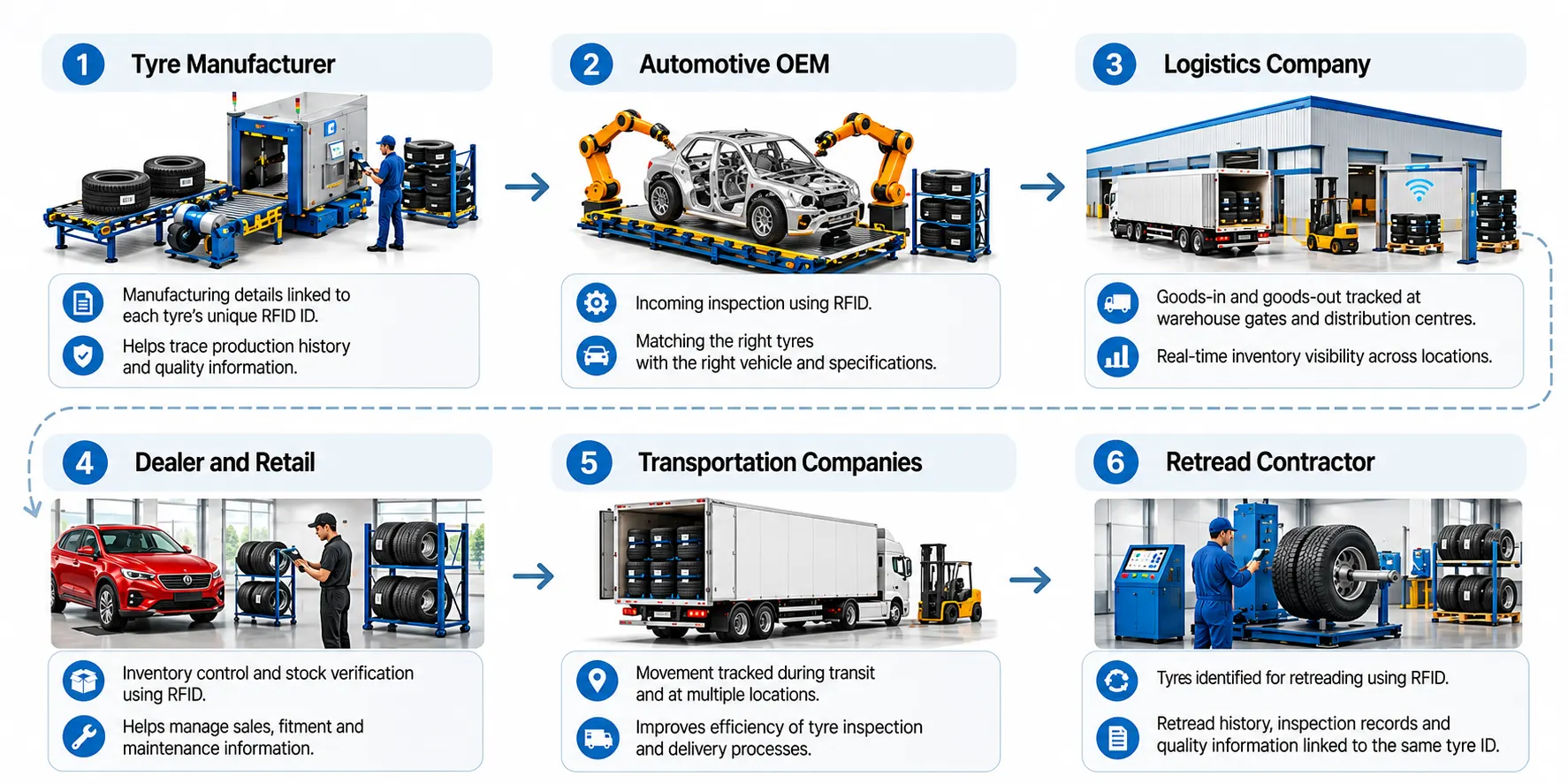
At the manufacturing stage, an RFID tag can be associated with a unique tyre identity and relevant production information.
When the tyre reaches an automotive OEM, that same identity can support incoming verification and identification during the production process.
Then comes logistics.
As tyres move through warehouses and distribution centres, fixed RFID readers at dock doors or warehouse gates can capture them during receiving and dispatch. Handheld readers can also be used for inventory checks where a fixed read point is not required.
At the dealer or retail location, RFID can continue to support inventory identification and stock management.
The lifecycle does not necessarily stop once the tyre is fitted to a vehicle.
For commercial fleets, its unique identity can be associated with inspection or maintenance information in the backend system. If the tyre later reaches a retreading facility, the same approach can be used to identify it and associate additional inspection or retread records.
This is a good example of what end-to-end supply chain traceability can look like.
RFID is not magically tracking the tyre everywhere it goes. Instead, its unique identity is being captured at relevant points throughout its lifecycle.
Those individual RFID events are what allow the software to build the larger traceability picture.
Where Should RFID Readers Be Installed?
This is one of the first questions that comes up while designing an RFID system.
And the answer is not “everywhere.”
A reader should be installed where capturing the movement actually gives us useful information.
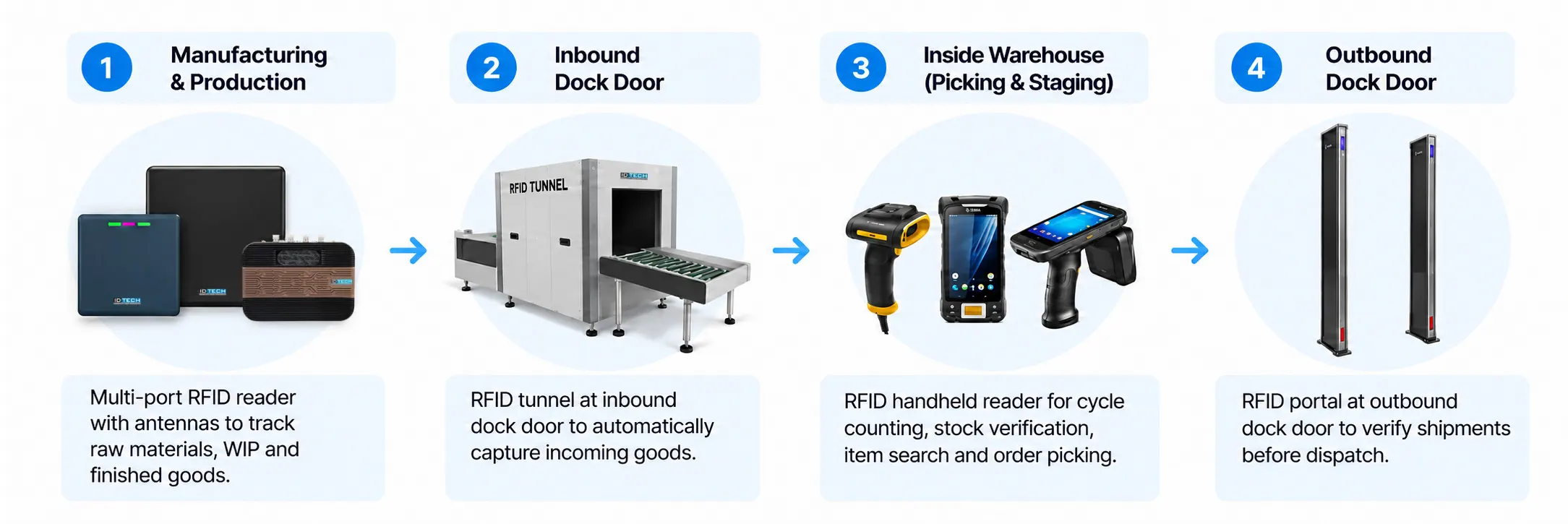
At Manufacturing and Production
RFID can identify raw materials, components, work-in-progress and finished goods.
If a component moves from one production stage to another, an RFID read point can automatically record that movement.
At the Inbound Dock Door
This is probably one of the most practical RFID read points in a warehouse.
A fixed reader with multiple antennas can create a read zone around the dock door. When a forklift carrying tagged goods enters, the tags can be identified automatically.
The system can then compare what was actually received with what was expected.
If 50 cartons were supposed to arrive and only 49 tagged cartons were identified, the team can investigate the difference during receiving rather than finding it during the next stock count.
Inside the Warehouse
Not every aisle needs a fixed reader.
For many warehouse activities, an RFID handheld reader makes more sense.
The operator can use it for cycle counting, stock verification, locating a particular EPC or checking inventory in an area.
This combination of fixed read points and handheld RFID is often more practical than trying to automate every square metre of a warehouse.
During Picking and Staging
Before goods are dispatched, RFID can be used as another verification layer.
The system can check whether the inventory moved into the staging area matches the order being prepared.
At the Outbound Dock Door
The outbound dock gives us another important checkpoint.
As the shipment leaves, RFID can verify what is physically moving through the door and compare it with the dispatch order.
If something is missing or an unexpected tagged item is being loaded, the system can flag it before the vehicle leaves.
And when the shipment reaches the next facility, the process starts again.
This is how individual read points gradually build end-to-end supply chain visibility.
What Does RFID Improve in Supply Chain Operations?
Receiving and Dispatch
RFID can reduce the manual scanning required during inbound and outbound operations.
Dock-door readers can automatically capture tagged inventory and compare it with expected receiving or dispatch information.
Inventory Counting
This is where handheld RFID readers are particularly useful.
Instead of checking items one by one, warehouse teams can identify multiple tagged items while moving through an inventory area.
Finding Misplaced Inventory
Sometimes the problem is not that an item is missing. It is simply in the wrong place.
An RFID handheld can search for a particular EPC and help the operator locate the tagged item.
Item-Level Traceability
A serialized RFID identity makes it possible to build a history around an individual item, carton, pallet or asset.
This becomes useful when businesses need more granular traceability instead of only SKU-level information.
Returnable Transport Items
Pallets, totes, crates, bins, stillages and other Returnable Transport Items are meant to come back.
But once thousands of these assets are circulating between plants, suppliers, warehouses and customers, keeping track of them becomes difficult.
Rugged RFID tags can give each RTI a unique identity so its movement, dwell time and return status can be recorded.
Where Is RFID Being Used Across Supply Chains?
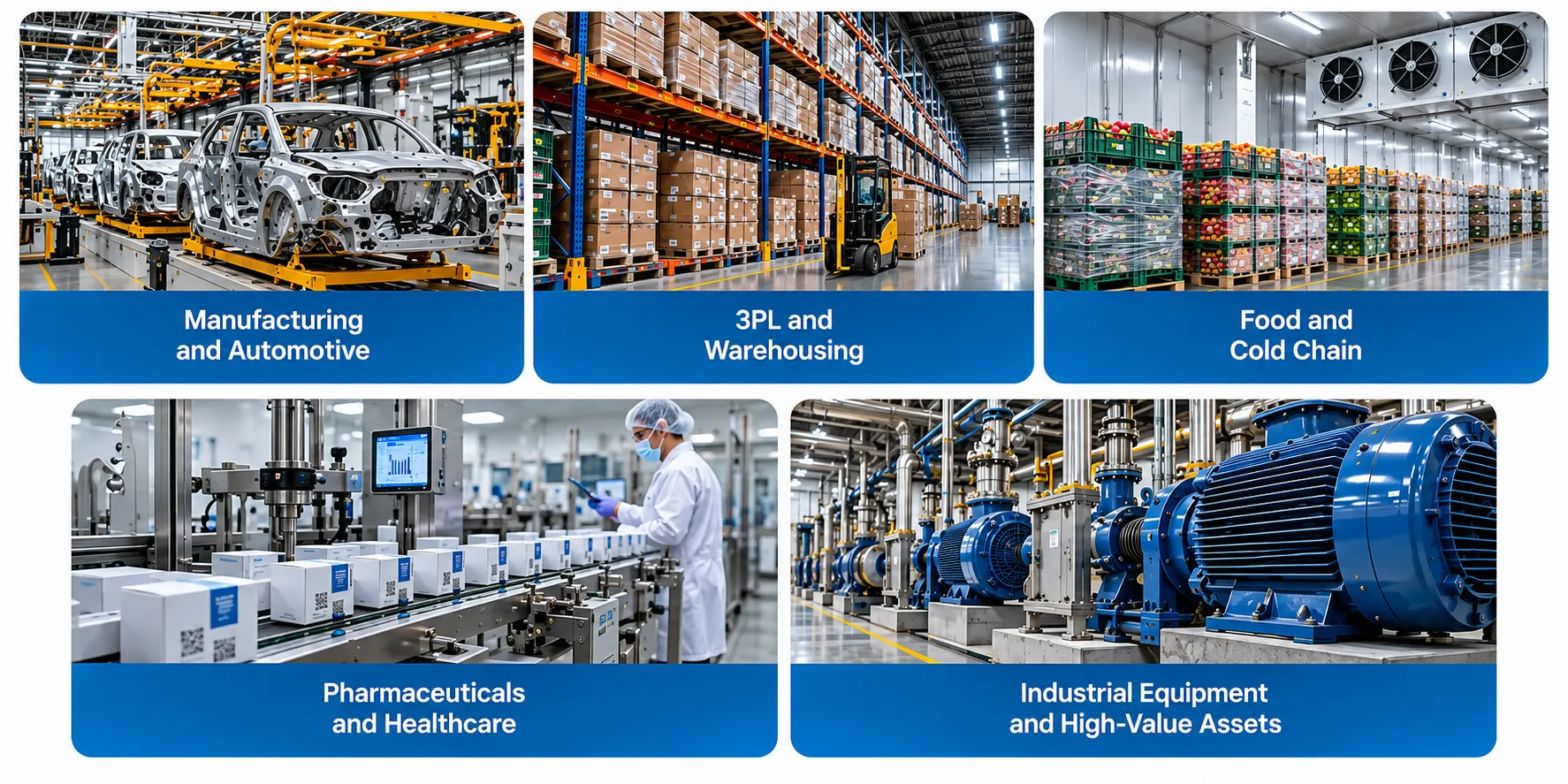
Manufacturing and Automotive
Manufacturers can use RFID for raw materials, WIP, components, tools, finished goods and returnable containers.
In automotive operations, RFID can also help verify whether the correct part or material has reached the required production area.
3PL and Warehousing
Warehouses and 3PL operators can use RFID during receiving, cycle counting, picking, cross-docking, staging and dispatch.
Because these facilities often handle large volumes of inventory, removing even some manual identification steps can make a significant operational difference.
Food and Cold Chain
RFID can identify cartons and pallets as they move through warehouses and cold-storage facilities.
When the RFID identity is connected with batch, lot and expiry information, it can also support FEFO processes and product traceability.
Pharmaceuticals and Healthcare
Here, serialization and traceability become particularly important.
RFID can support the identification of products, cartons and logistics assets while the backend system maintains the related business and movement records.
Industrial Equipment and High-Value Assets
Supply chains are not only about cartons and pallets.
Tools, equipment, cylinders and reusable industrial assets also move between locations. Rugged and on-metal RFID tags can provide unique identification for these assets, while handheld readers make field verification easier.
What Does a Complete RFID System Need?
An RFID solution is much more than a tag and a reader.
RFID Tags
The RFID tag is attached to the object and provides its unique identity.
The actual tag depends on the material, environment, required read range and how the object moves through the operation. ID Tech offers different options including UHF labels, rugged tags, on-metal RFID tagsand pallet tags for different supply chain applications.
Fixed RFID Readers
Fixed RFID readers are used where identification needs to happen automatically.
They are commonly installed at dock doors, gates, conveyors and other defined read points. Multi-port readers also allow multiple antennas to be positioned around a read zone depending on the application.
RFID Antennas
The RFID antenna creates the RF coverage around the read point.
Its gain, polarization, mounting height and angle all matter. The objective is not to create the biggest possible RF field. It is to create the right read zone for that particular operation.
RFID Handheld Readers
RFID handheld readers fill the gaps where fixed infrastructure is not practical.
They are useful for cycle counts, stock search, receiving checks and exception handling, especially when operators need to move around the warehouse and identify inventory at different locations.
RFID Tunnels
For conveyor-based operations, an RFID Tunnel can create a more controlled reading environment.
It combines a reader, multiple antennas and RF shielding to identify tagged items inside the required zone while reducing unwanted reads from nearby inventory. The system can also be integrated with ERP or WMS platforms for automated warehouse processes.
Middleware
Middleware is the layer that makes raw RFID data useful.
A reader might see the same tag many times while it remains inside the RF field. The WMS does not need hundreds of copies of the same read.
Middleware filters those reads, applies the required business logic and creates a meaningful event.
For example:
Pallet 123 was received at Dock Door 3 at 10:32 AM.
That information is much more useful to the business than a continuous stream of raw EPC reads.
WMS and ERP Integration
Finally, that RFID event needs to reach the system managing the operation.
Depending on the application, this could be a WMS, ERP, TMS or another enterprise platform. ID Tech’s RFID readers support SDKs, APIs and interfaces for integration with ERP, WMS and IoT ecosystems.
This integration is what turns RFID hardware into RFID supply chain automation.
The hardware tells us what happened physically. The software gives that event business meaning.
What Is Next for RFID in Supply Chain Traceability?
RFID is increasingly becoming one part of a much larger connected operation.
RFID Data and AI
Once businesses have reliable movement data, analytics can start finding patterns within it.
Which inventory spends too long in staging? Where are RTIs getting stuck? Which location repeatedly sees dispatch delays?
RFID can provide the physical-world data behind these questions. AI and analytics can then help make sense of it.
Autonomous Warehouses
AGVs and autonomous mobile robots are already changing how goods move inside warehouses.
RFID readers can be integrated into automated systems so inventory information is collected as part of normal warehouse movement rather than through a separate manual audit.
Digital Product Passports
Another area to watch is the Digital Product Passport.
As product lifecycle and sustainability information becomes more important, technologies such as RFID can help connect a physical product with its digital identity.
The tyre example is a good way of thinking about this. The product may move through manufacturing, use, maintenance and eventually another lifecycle stage, while its unique identity provides a reference point for the information created along the way.
From Visibility to Traceability
RFID does not change the physical journey of a product. The carton still needs to leave the plant. The pallet still needs to enter the warehouse. The forklift still needs to move it. And the shipment still needs to reach the next location.
What RFID changes is how automatically and accurately we can capture that journey.
The tag gives the item an identity. The reader and antenna capture it. The read point tells us where it was identified. Middleware cleans and interprets the RFID data. And the WMS or ERP connects that event with the actual operation.
When these pieces work together, RFID is no longer just a faster way to count inventory.
It becomes a way to build real-time inventory visibility and traceability across the supply chain, one read point at a time.
Looking at RFID for your warehouse, manufacturing or logistics operation? Explore ID Tech’s RFID product portfolio or connect with our RFID team to discuss the tags, readers, read points and software integration required for your application.
Frequently Asked Questions
1. What is an RFID supply chain management system?
It uses RFID tags, readers, antennas and software to identify products, cartons, pallets or assets as they move through the supply chain. RFID events can then be integrated with WMS, ERP, TMS or other business applications.
2. What is the difference between RFID and barcodes?
Barcodes normally require optical line of sight and are generally scanned individually. RFID uses radio waves, does not require the same direct line of sight and can identify multiple tagged objects during a reading operation.
3. What is the difference between RFID and GPS?
RFID identifies a tagged object when it enters a reader’s read zone. GPS provides geographical positioning and is more suitable when a vehicle or powered asset needs to be tracked over a larger geographical area.
4. Can RFID work on metal?
Yes, but the right tag needs to be used. Standard UHF labels can perform poorly directly on metal, which is why on-metal RFID tags are designed for metal pallets, containers, equipment and other metallic assets.
5. What about liquids?
Liquids can affect UHF RFID performance. Tag position, antenna placement and the product itself therefore need to be considered during system design and tested during the POC.
6. Can RFID read pallets while a forklift is moving?
Yes. A properly designed dock-door read point can identify tagged pallets or cartons while a forklift passes through.
The actual performance depends on the tags, speed, antenna placement, reader configuration and surrounding RF environment.
7. What is the read range of UHF RFID?
There is no fixed number.
Read range depends on the RFID tag, antenna, reader power, orientation, mounting surface and operating environment. This is why read range should always be considered in the context of the actual application.
8. Why is UHF RFID commonly used in supply chains?
Passive UHF RFID, commonly associated with RAIN RFID and EPC Gen2 / ISO 18000-6C, offers the read range, speed and multiple-tag identification needed for many warehouse and logistics applications.
It is therefore commonly used for cartons, pallets, RTIs, warehouse inventory and industrial assets.