Retail inventory looks simple until the stock shown in the system does not match what is actually available on the shelf. An item may appear available online but be missing from the store, sitting in the wrong location, still packed in the stockroom, or already sold without the inventory record being properly updated.
These gaps create more than an inventory problem. They lead to lost sales, out-of-stock situations, unnecessary replenishment, cancelled online orders and a poor customer experience.
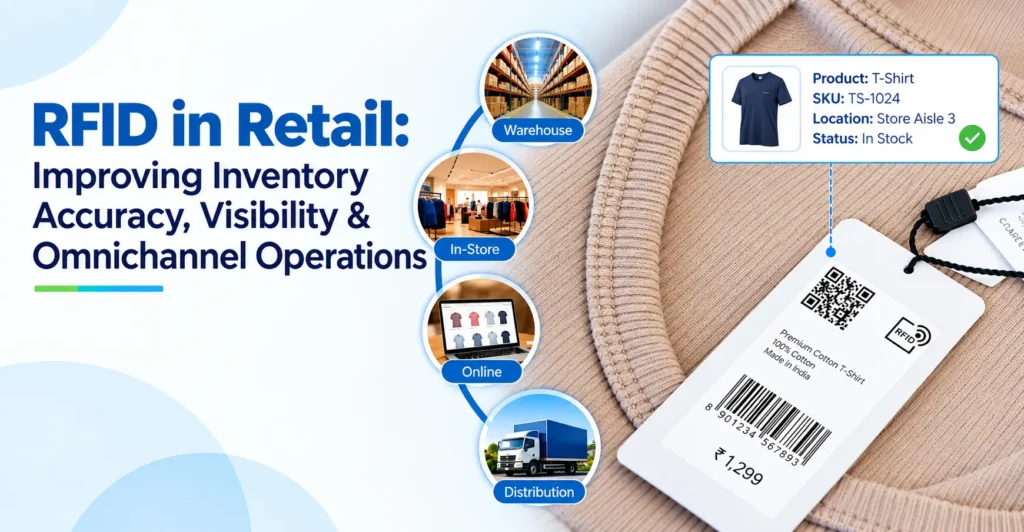
This is where RFID in Retail: Inventory Accuracy, Visibility & Omnichannel Operations becomes important. Instead of relying only on individual barcode scans and periodic physical counts, RFID gives retailers a faster way to identify, count and track individual products across stores, warehouses and distribution centres.
GS1 US highlights real-time visibility, information accuracy and operational efficiency among the major benefits of RFID inventory management. RFID also supports omnichannel fulfilment by giving retailers more reliable information about what inventory is actually available.
For retailers, the real value of RFID is not simply reading a tag. It is knowing what product is available, where it is, and whether it can actually be promised to a customer.
How RFID Tags for Retail Inventory Work
An RFID system connects the physical product with its digital inventory record.
A typical retail system includes an RFID tag attached to the product, an RFID reader or handheld device, antennas where required, middleware and the retailer’s inventory, ERP, WMS, POS or e-commerce platform.
Different Products Need Different RFID Tags
There is no single RFID tag suitable for every retail product.
Depending on the product and packaging, RFID can be integrated into:
- Garment hangtags
- Adhesive product labels
- Care labels
- Footwear labels
- Hard security tags
- Packaging labels
- Specialty tags for products containing metal or liquids
For example, an apparel retailer may integrate the RFID inlay directly into a price or care label, allowing RFID identification to become part of the existing product labelling process.
One Product, One Digital Identity
One of the biggest differences between traditional inventory identification and item-level RFID is serialization.
A barcode normally identifies the product or SKU. RFID can go a step further by assigning an individual serialized Electronic Product Code, or EPC, to each physical item.
GS1 defines EPC as a syntax for unique identifiers that can be assigned to products and other identifiable entities.
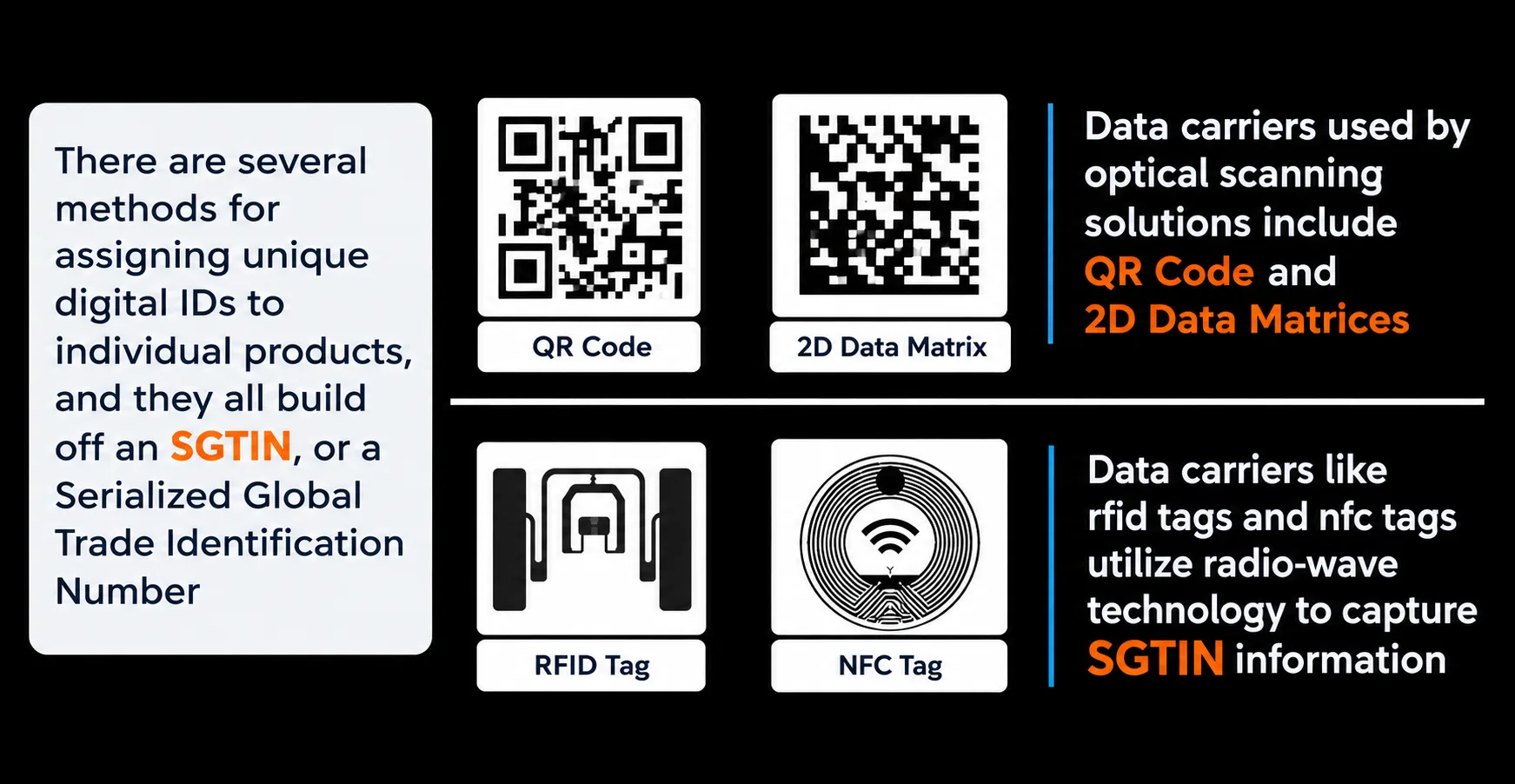
Consider 50 identical black shirts in the same size. The SKU tells the retailer that they are the same product. RFID serialization can distinguish shirt 1 from shirt 2, shirt 3 and every other individual unit.
That individual identity becomes valuable when products move through receiving, stockrooms, sales floors, checkout, returns and fulfilment.
Why RFID Improves Retail Inventory Accuracy and Visibility
The biggest operational advantage of RFID is that it does not require every item to be individually located and scanned like a barcode.
A store associate can walk through a stockroom or sales floor with an RFID handheld and capture multiple tagged items without direct line of sight. Fixed RFID infrastructure can also capture tagged inventory automatically at selected movement points.
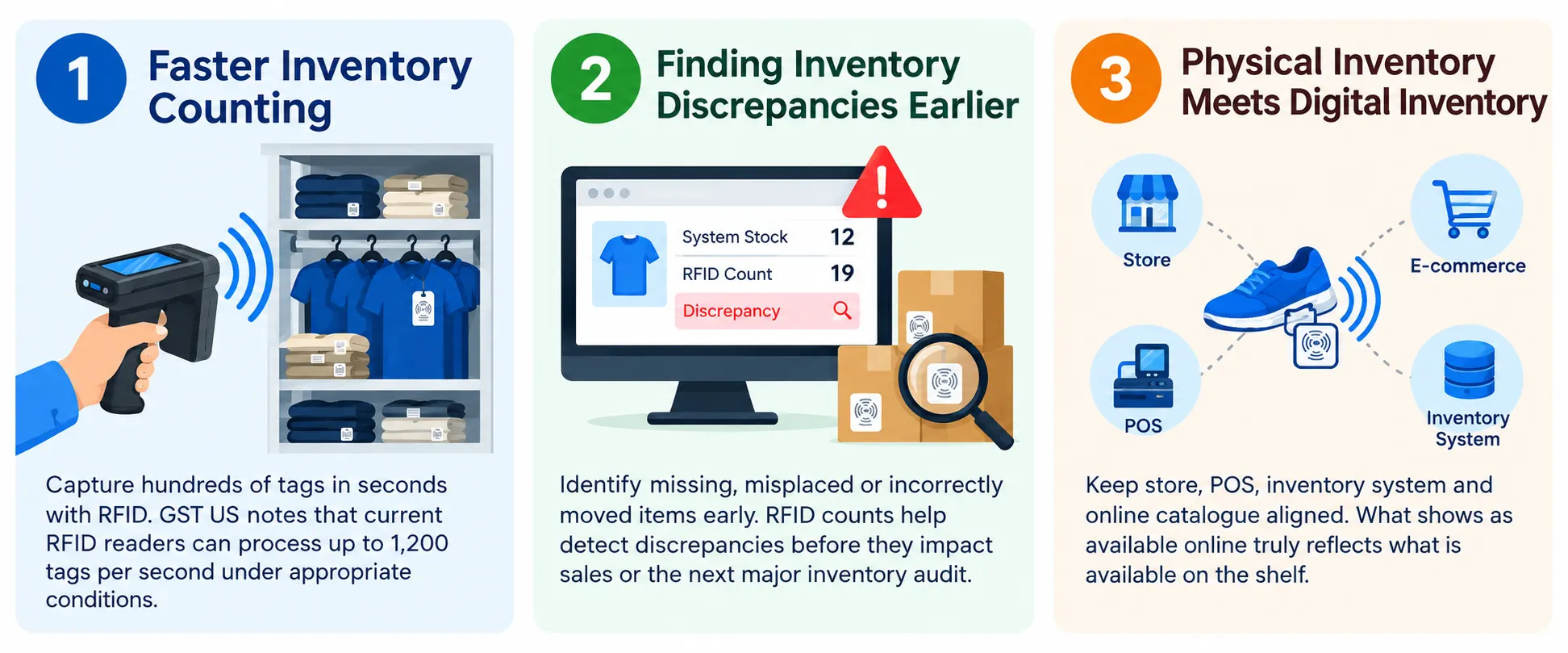
Faster Inventory Counting
Traditional physical inventory can require employees to find products and scan barcodes one by one.
With RFID, hundreds of tags can be captured rapidly. GS1 US notes that current RFID readers can process up to 1,200 tags per second under appropriate conditions.
This makes it practical to conduct cycle counts much more frequently instead of waiting for occasional full physical audits.
Finding Inventory Discrepancies Earlier
Suppose the inventory system says that a store has 12 units of a product, but an RFID count identifies only nine.
The retailer now has an actionable discrepancy.
The missing units could have been misplaced, sold incorrectly, transferred without an update, lost or stolen. Frequent RFID counts allow these differences to be detected earlier rather than discovering them during the next major inventory audit.
Research from Auburn University’s RFID Lab has demonstrated that RFID-enabled visibility can reduce inventory record inaccuracies in real retail environments.
Physical Inventory Meets Digital Inventory
This is particularly important for omnichannel retail.
The e-commerce platform may say “3 available”, but those three units only matter if employees can actually find them when an online order arrives.
RFID helps keep the physical store, POS, inventory system and online catalogue working from a more accurate inventory picture.
Key Benefits of RFID Inventory Management in Retail
1. Higher Inventory Accuracy
Accurate inventory is the foundation of RFID retail automation.
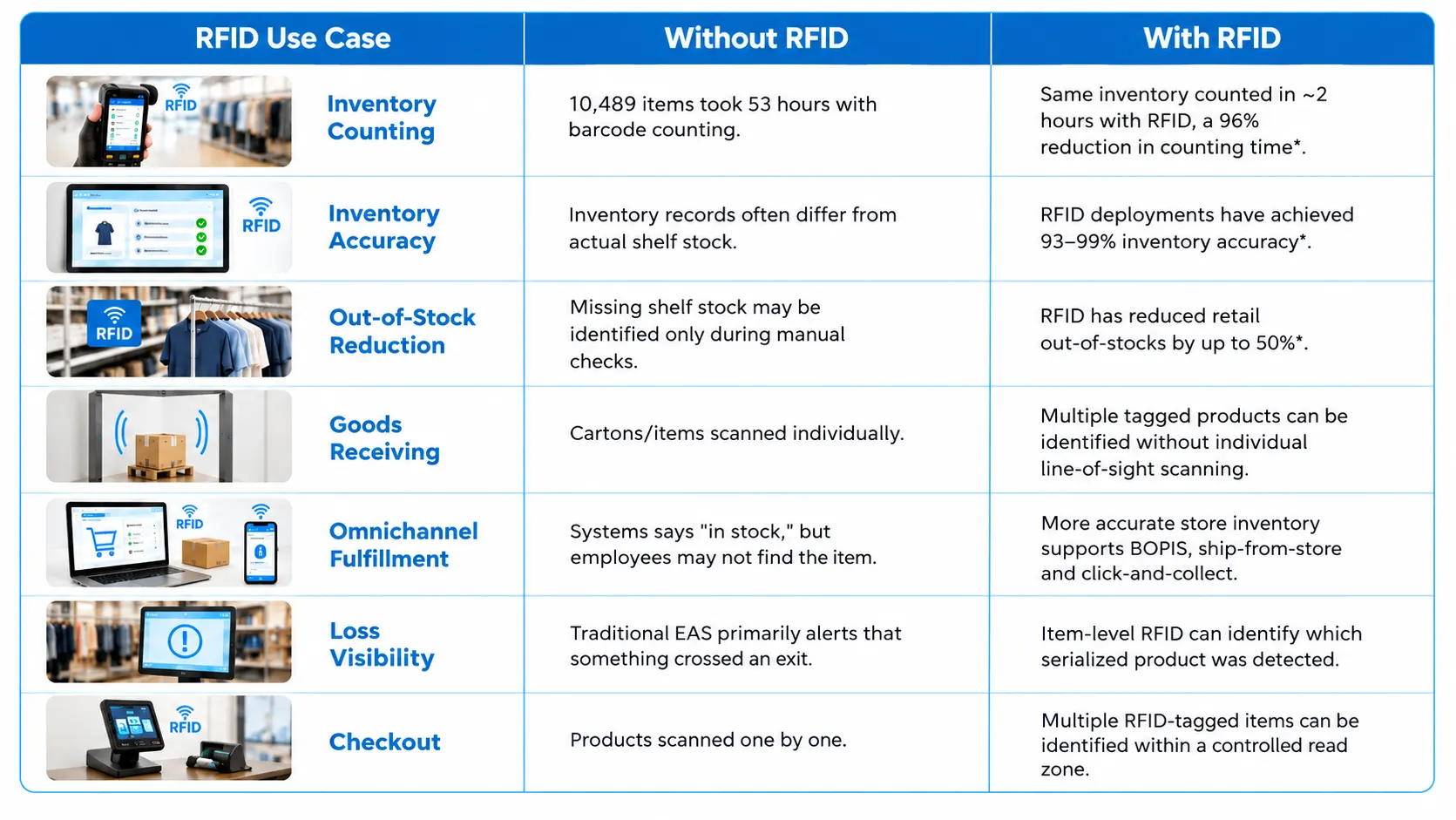
GS1 US states that RFID can raise item-level inventory accuracy to over 95%. McKinsey has also documented retail deployments achieving inventory accuracy around 98%, although actual results depend on the retailer, implementation and operating processes.
Higher accuracy means employees spend less time searching for inventory that the system says should be there but physically cannot be found.
2. Better Retail Stock Visibility
RFID creates visibility at multiple stages of the product journey.
Readers can be deployed at distribution centres, receiving areas, stockrooms, store floors and checkout points depending on the use case.
Instead of seeing only a quantity in an ERP, retailers can build a clearer picture of how inventory is moving through their operations.
3. More Reliable Omnichannel Inventory Management
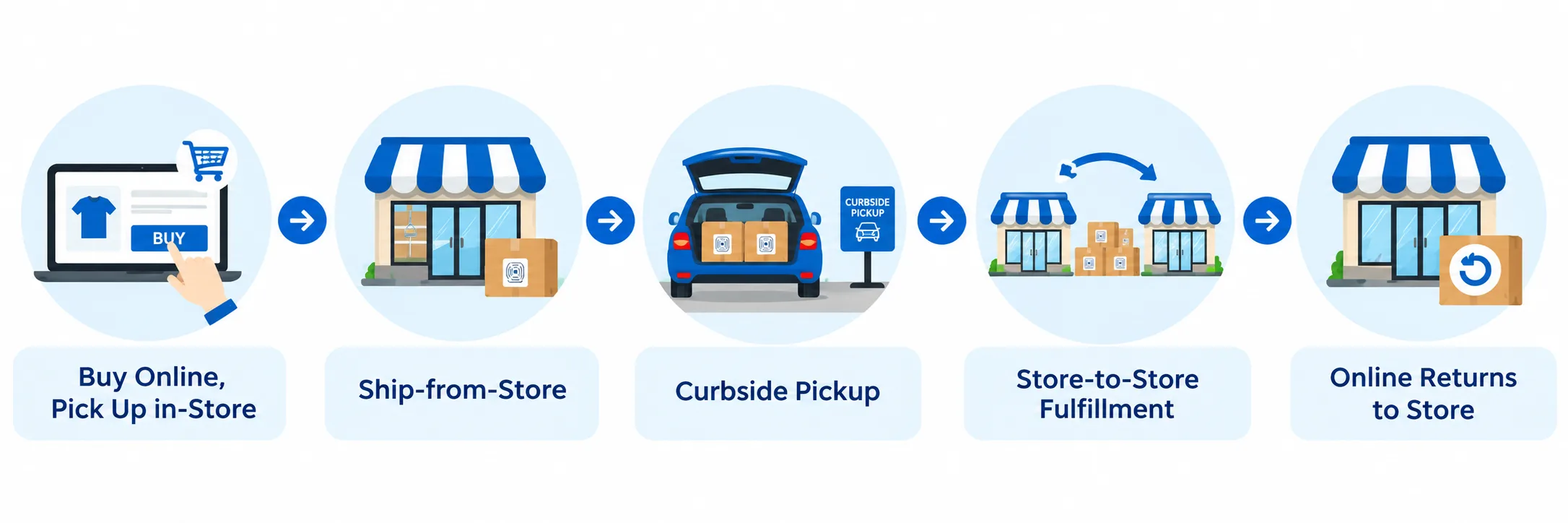
BOPIS, click-and-collect, curbside pickup and ship-from-store all depend on one thing: trusting the inventory shown in the system.
If an online customer purchases the last available unit but the product cannot be located in the store, the order may need to be cancelled or fulfilled from another location.
RFID helps reduce this gap between digital availability and physical availability. McKinsey specifically identifies RFID-enabled inventory accuracy as an enabler for BOPIS, curbside pickup and broader omnichannel fulfilment.
4. Faster Replenishment
RFID can identify products that are available in the backroom but missing from the sales floor.
Instead of assuming an item is out of stock and triggering unnecessary replenishment, employees can locate existing inventory and move it where customers can actually purchase it.
GS1 US reports that RFID implementations can reduce retail out-of-stocks by up to 50%, based on GS1 and Auburn University research.
5. Faster Checkout
RFID can also change the checkout process.
Rather than scanning each barcode individually, an RFID-enabled checkout station can identify multiple tagged products within its controlled read zone. This can support assisted checkout as well as self-checkout applications.
The exact setup depends heavily on tag placement, read-zone design, products and store environment.
6. Better Shrink and Loss Visibility
RFID does not automatically prevent theft, but item-level serialization gives retailers better data about inventory discrepancies.
When combined with POS, inventory and loss-prevention systems, retailers can understand which items disappeared, when discrepancies occurred and where inventory records stopped matching physical stock.
McKinsey notes shrinkage reduction as one of the areas where retailers have demonstrated business value from RFID deployments.
RFID Retail Use Cases at a Glance
RFID can support different processes across a retail operation, from inventory counting and replenishment to receiving, omnichannel fulfilment and checkout.
The hardware and business impact will vary by store format, product category and deployment design, but published retail studies show where RFID is already delivering measurable operational improvements.
Where RFID Retail Automation Can Be Used
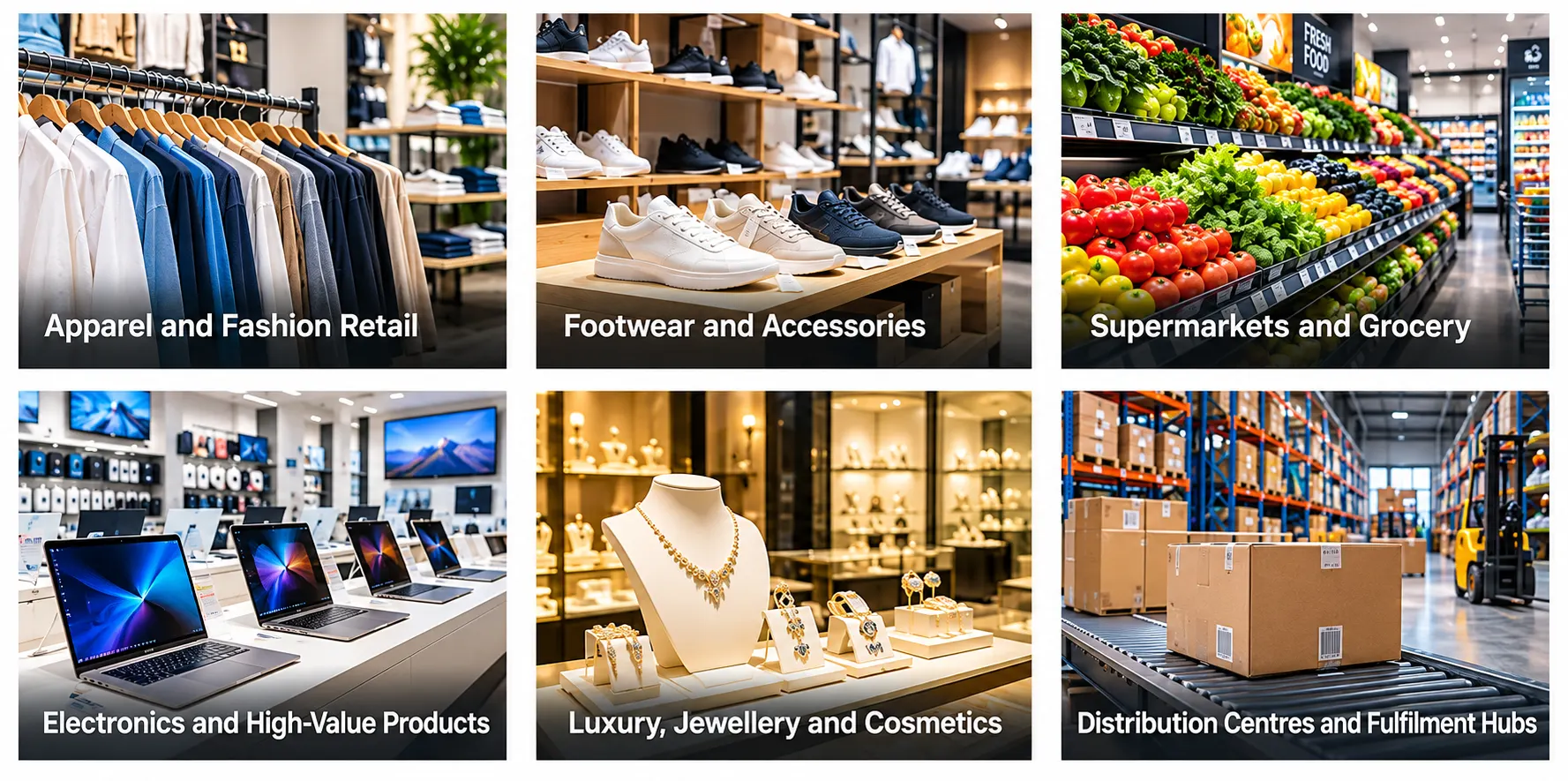
Apparel and Fashion
Apparel remains one of the strongest applications for item-level RFID.
A store may carry the same garment across multiple sizes, colours and styles. RFID allows employees to count these products quickly, find misplaced stock and determine whether a missing size is actually unavailable or simply sitting somewhere else in the store.
RFID can also support smart fitting rooms, self-checkout and item-level customer experiences.
Footwear and Accessories
The product displayed on the sales floor and the actual inventory stored in boxes in the backroom can be very different.
RFID allows associates to search for the required size or model more quickly and maintain better visibility of boxed inventory.
Supermarkets and Grocery
RFID can support selected grocery applications such as case tracking, reusable transport items, inventory movement and expiration-related processes.
However, grocery deployments require careful tag and antenna selection because liquids, metals, dense product arrangements and packaging materials can affect UHF RFID performance.
Electronics and High-Value Products
Individual serialization can support inventory control, product movement, warranty processes and loss-prevention workflows for electronics and other high-value merchandise.
Specialized RFID tags may be required when products or packaging contain metal.
Luxury, Jewellery and Cosmetics
For higher-value products, RFID can support serialized inventory management, authenticity-related processes and detailed movement records.
In these environments, the solution should be designed around the product rather than forcing a standard retail label onto every item.
Distribution Centres and Fulfilment Hubs
RFID does not have to start at the store.
Fixed readers can capture tagged cases or items during receiving, picking, packing and dispatch. GS1 US notes that RFID-enabled read points can automatically capture tagged cartons as they move through areas such as loading docks, forklifts and conveyors.
This creates visibility before inventory even reaches the retail floor.
Components of an RFID-Based Retail Inventory Management System
A successful RFID deployment is not just about selecting a tag. Tags, readers, antennas and software must work together.
RFID Tags
The RFID tag creates the digital identity of the product.
For retail, this may include passive UHF labels, apparel tags, hangtags, embedded labels or specialty tags depending on the material and product category.
ID Tech offers UHF RFID tags for applications including garments, inventory management and product tracking.
Explore ID Tech RFID Tags
RFID Readers
Readers communicate with the RFID tags and transfer captured information to the software layer.
Retail deployments can use fixed readers at defined read points, handheld readers for inventory counting and product search, or compact desktop readers for encoding and checkout applications.
Explore ID Tech RFID Readers and Products
RFID Antennas
The antenna determines where the RFID energy is directed and plays an important role in creating the required read zone.
Different applications may require different antenna gains, polarization and mounting positions.
A stockroom doorway, checkout counter and warehouse dock door should not automatically use the same antenna configuration.
Explore ID Tech RFID Antennas and Products
Handheld RFID Readers
Handheld readers are particularly useful for retail cycle counting.
Employees can move through racks, shelves and stockrooms while continuously reading nearby RFID-tagged products. The same device can also be used to search for a specific item.
Explore ID Tech RFID Handheld and Products
RFID Encoding
Before a product can be identified, its RFID tag needs to contain the correct EPC or required identification data.
Desktop encoding stations can associate the RFID tag with the corresponding product record during source tagging, receiving or other defined processes.
For example, ID Tech’s IDT-107 supports EPC Gen2/ISO 18000-6C compatible UHF tags and can be used for RFID reading and encoding workflows.
Explore the IDT-107 UHF RFID Reader
RFID Solutions Built for Retail Operations
Beyond inventory counting, RFID can automate specific processes across the retail journey, from product receiving and encoding to customer interaction and checkout.
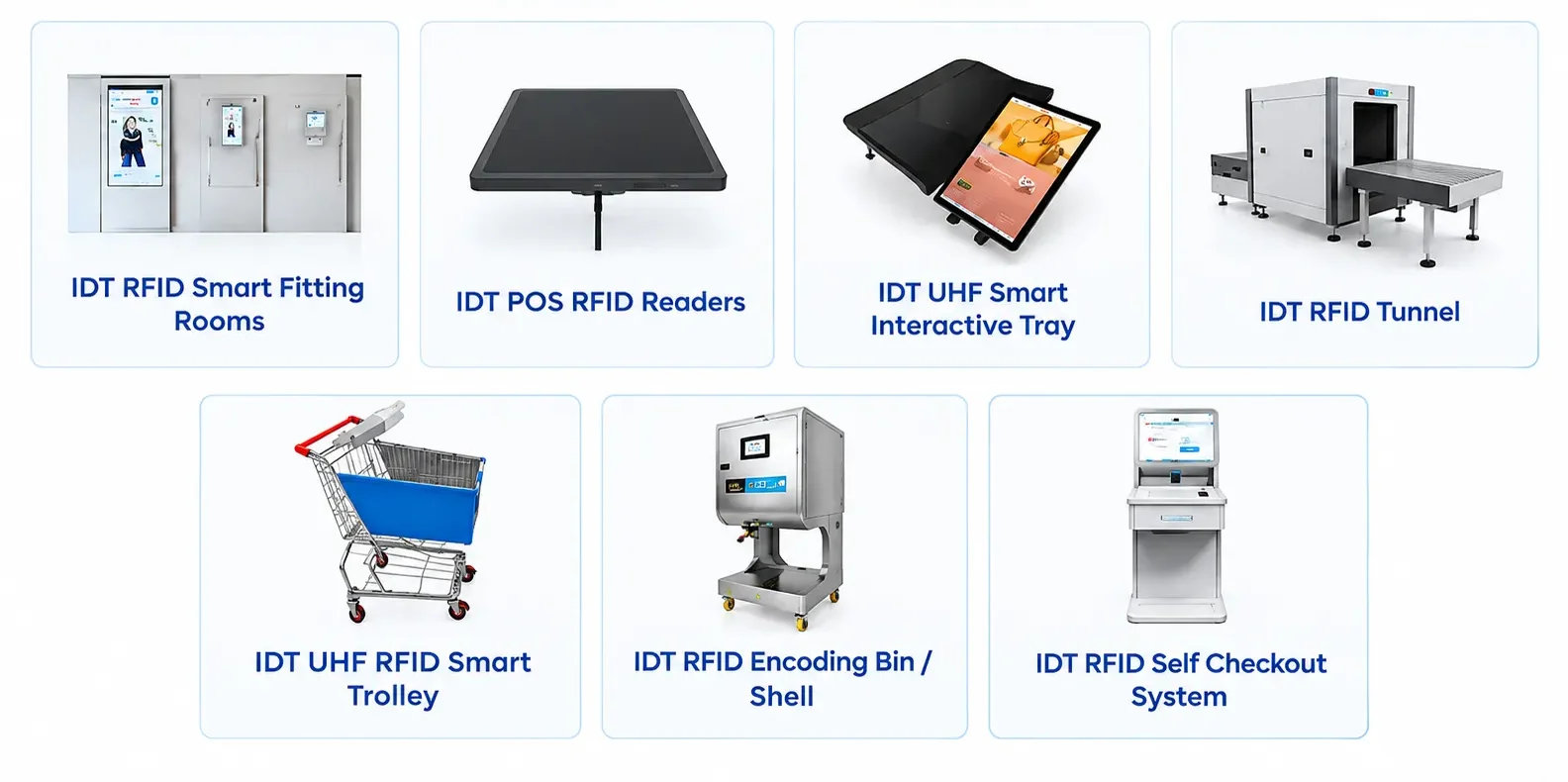
RFID Self-Checkout System
Customers can place multiple RFID-tagged products in the checkout area for automatic identification instead of scanning each barcode individually. The system can be customized and integrated with existing POS and payment workflows.
Explore RFID Self-Checkout System
RFID POS Reader
A compact RFID reader for checkout counters that enables rapid identification of multiple tagged products within a controlled read zone, supporting faster billing and retail POS integration.
RFID Smart Fitting Room
Automatically detects RFID-tagged garments taken into the fitting room and can connect shoppers with product information, available sizes, alternatives and related recommendations.
RFID Smart Trolley
Enables products placed inside a shopping trolley to be identified automatically, supporting smarter shopping and checkout experiences.
RFID Encoding Bin / Shell
Provides a controlled RFID environment for encoding and associating tags with individual products before they enter inventory, helping retailers establish item-level identity from the beginning.
RFID Tunnel
Designed for automated bulk identification of RFID-tagged products, cartons or packages during receiving, dispatch and fulfilment operations without scanning every item individually.
UHF RFID Smart Interactive Tray
Automatically identifies tagged products placed on the tray and can trigger relevant product information on a connected display, making it useful for jewellery, cosmetics, electronics and other high-value retail categories.
RFID and Omnichannel Retail: Why Inventory Accuracy Matters
Imagine a customer checking a retailer’s website at 10 AM.
The website says that a pair of shoes is available at the nearest store. The customer places a click-and-collect order.
An employee goes to pick it, but the product is not where the inventory system says it should be.
The result is a cancelled order and a disappointed customer.
This is why omnichannel is ultimately an inventory accuracy problem.
RFID allows retailers to conduct frequent counts and reconcile their system inventory with physical stock. The better the inventory data, the more confidently retailers can expose store inventory to online customers.
This supports:
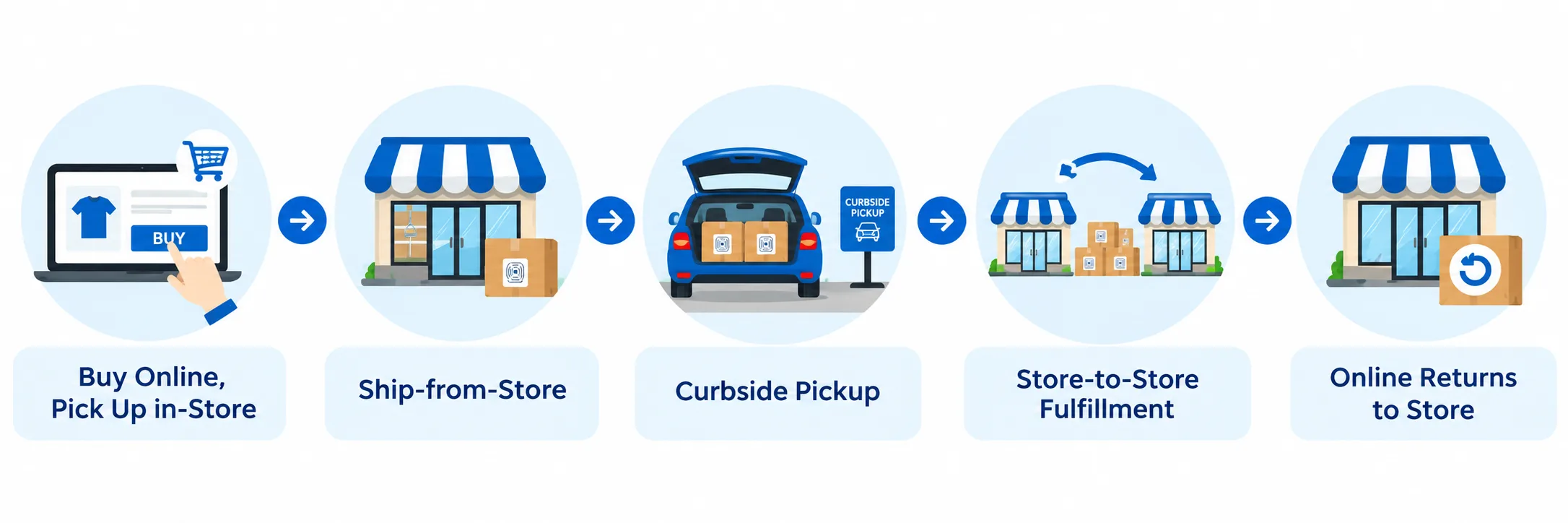
The same product identity can continue through each process.
Future of RFID in Retail
RFID is increasingly becoming more than a stock-counting technology.
RFID Data + AI
AI-based forecasting is only as useful as the data being fed into it.
When RFID provides more accurate information about what is actually available and where it is located, retailers can use that information alongside sales history and demand signals for better replenishment and forecasting decisions.
Autonomous Inventory Counting
Retailers are also exploring robots and autonomous systems equipped with RFID readers to perform inventory scans.
Instead of employees conducting every count manually, autonomous equipment can potentially scan selected environments during off-hours and continuously update inventory information.
Smarter Stores and Frictionless Checkout
RFID-enabled checkout can reduce dependence on scanning products individually.
Combined with controlled read zones, POS integration and item-level tagging, RFID can support faster self-checkout and increasingly automated store concepts.
RFID and Digital Product Passports
Another important development is the emergence of the Digital Product Passport (DPP).
The European Union’s DPP framework is designed to make product information available throughout the product lifecycle and improve transparency, traceability and circularity. The European Commission launched its DPP Registry and testing environment in July 2026.
For retail, technologies such as RFID can potentially act as physical product identifiers connecting products with digital information used for authentication, repair, resale, recycling and lifecycle management, depending on the applicable implementation and regulatory requirements.
RFID vs Barcode for Retail Inventory
Barcode technology will continue to have an important role in retail. RFID does not need to replace every barcode to create value.
The major difference is how information is captured.
A barcode normally requires the scanner to see and scan each code individually. UHF RFID can identify multiple tagged products without direct line of sight.
That difference becomes significant when a retailer needs to count 100 products, 10,000 products or inventory across hundreds of stores.
Barcode works well when the question is:
“What is this product?”
RFID becomes particularly useful when the question is:
“What products are here, which individual items are they, and what is missing?”
From Inventory Counting to Connected Retail
RFID in retail is no longer only about making stock counts faster.
Its bigger value comes from connecting physical products with digital inventory.
When retailers know what has been received, stored, moved, made available and sold, they can improve replenishment, reduce inventory discrepancies and make omnichannel fulfilment more dependable.
And that is where RFID becomes more than a tracking technology.
It becomes part of the infrastructure behind a connected retail operation.
Ready to Improve Your Retail Inventory Visibility?
Whether you are exploring item-level RFID tagging, automated inventory counting, RFID-enabled checkout or omnichannel inventory management, the right solution starts with understanding the products, environment and existing retail systems.
Talk to our RFID experts to discuss your retail application or book an RFID demo to see inventory visibility in action.
Frequently Asked Questions
1. Which RFID handheld is suitable for retail inventory?
A UHF RFID handheld such as the IDT RHC72 can be used for fast stock counting, item search, receiving and inventory verification.
2. Can RFID integrate with our existing POS, ERP or WMS?
Yes. RFID readers and middleware can integrate with existing POS, ERP, WMS and inventory management systems through APIs or SDKs.
3. Is the RFID self-checkout system customizable?
4. Do we need a handheld or fixed RFID reader?
Handheld readers are ideal for stock counts and item search. Fixed readers are better for automated receiving, movement tracking, checkout and other defined read points.
5. Can RFID read multiple products at once?
Yes. UHF RFID can identify multiple tagged products simultaneously without scanning each barcode individually.
6. Which RFID tags are suitable for retail?
It depends on the product. RFID labels and hangtags work well for apparel and footwear, while metal or liquid-based products may require specialized tags.
7. What other RFID systems can be used in retail?
RFID can support smart fitting rooms, POS readers, smart trolleys, encoding bins, RFID tunnels and interactive trays, depending on the application.
8. Can the same RFID system support omnichannel operations?
Yes. Accurate item-level inventory can support BOPIS, click-and-collect, ship-from-store and store-to-store fulfilment.