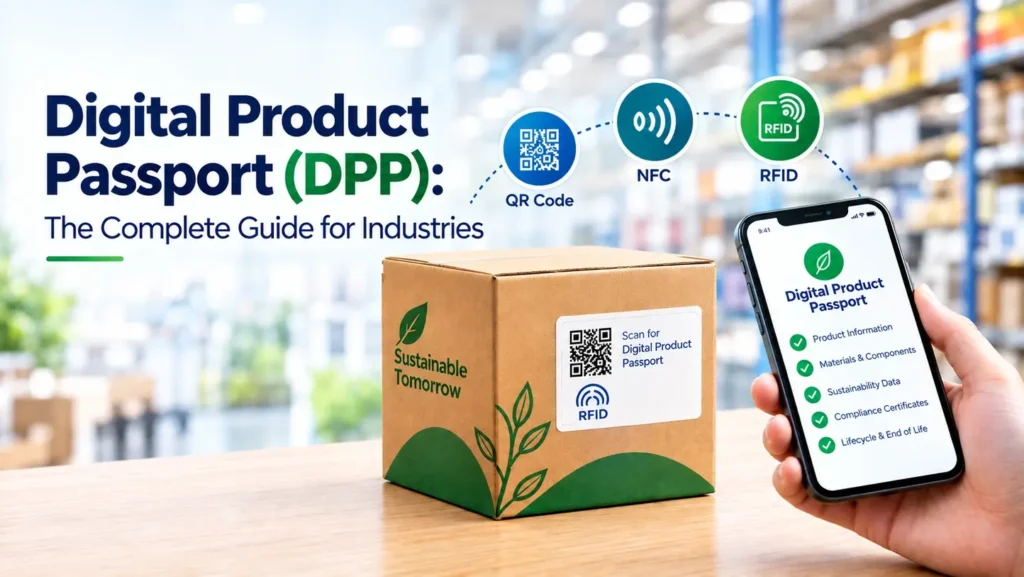
Digital Product Passport, or DPP, is quickly becoming an important topic for manufacturers, exporters and businesses selling products into the European Union. But with different regulations, product categories and timelines involved, there is still a lot of confusion around what DPP actually means in practice.
What information will a DPP contain? When will it become mandatory? Will Indian exporters need to comply? And where do technologies such as QR codes, NFC and RFID fit into the picture?
This guide answers these questions in a simple, practical way, with a focus on what industries need to know and how they can start preparing.
What is a Digital Product Passport and how does it work?
A Digital Product Passport (DPP) can be understood as a digital identity for a physical product, component or material. It connects a product with relevant digital information about its origin, materials, sustainability, compliance and lifecycle.
According to the European Commission, a DPP can be accessed by scanning a data carrier placed on the product, its packaging or accompanying documentation, depending on the requirements defined for that product category.
In simple terms, the physical product gets an identity, and that identity connects users to its digital information.
Why is the Digital Product Passport being introduced?
The DPP is closely connected with the EU’s broader move towards a circular economy, where products are designed to last longer and information remains available beyond the point of sale.
Today, important product information often sits across different supplier records, ERP systems, certificates, labels and databases. DPP aims to make relevant information more structured and accessible throughout the product lifecycle.
For manufacturers, this can improve traceability and information sharing. Consumers may gain better visibility into what a product contains and how it can be maintained or repaired. Repairers and recyclers can potentially access information that helps extend the life of products and recover materials more effectively.
The European Commission describes DPP as a digital information container that can include sustainability, lifecycle and compliance information.
Which regulation governs the Digital Product Passport?
The main legal framework is the Ecodesign for Sustainable Products Regulation (ESPR), Regulation (EU) 2024/1781.
However, ESPR does not mean that every product suddenly requires a passport. Product-specific delegated acts will determine which products require a DPP, what information must be included and the final compliance requirements.
Some products can also receive DPP requirements through separate EU legislation. The European Commission specifically identifies regulations covering batteries, toys and construction products as examples.
For businesses looking specifically at the legislation, our full DPP regulation breakdown covers this in more detail.
When will the Digital Product Passport become mandatory?
There is no single DPP deadline for every industry.
The first ESPR Working Plan provides an indicative schedule for priority product groups. Iron and steel are scheduled for 2026, textiles, tyres and aluminium for 2027, furniture for 2028, and mattresses and ICT products for 2029.
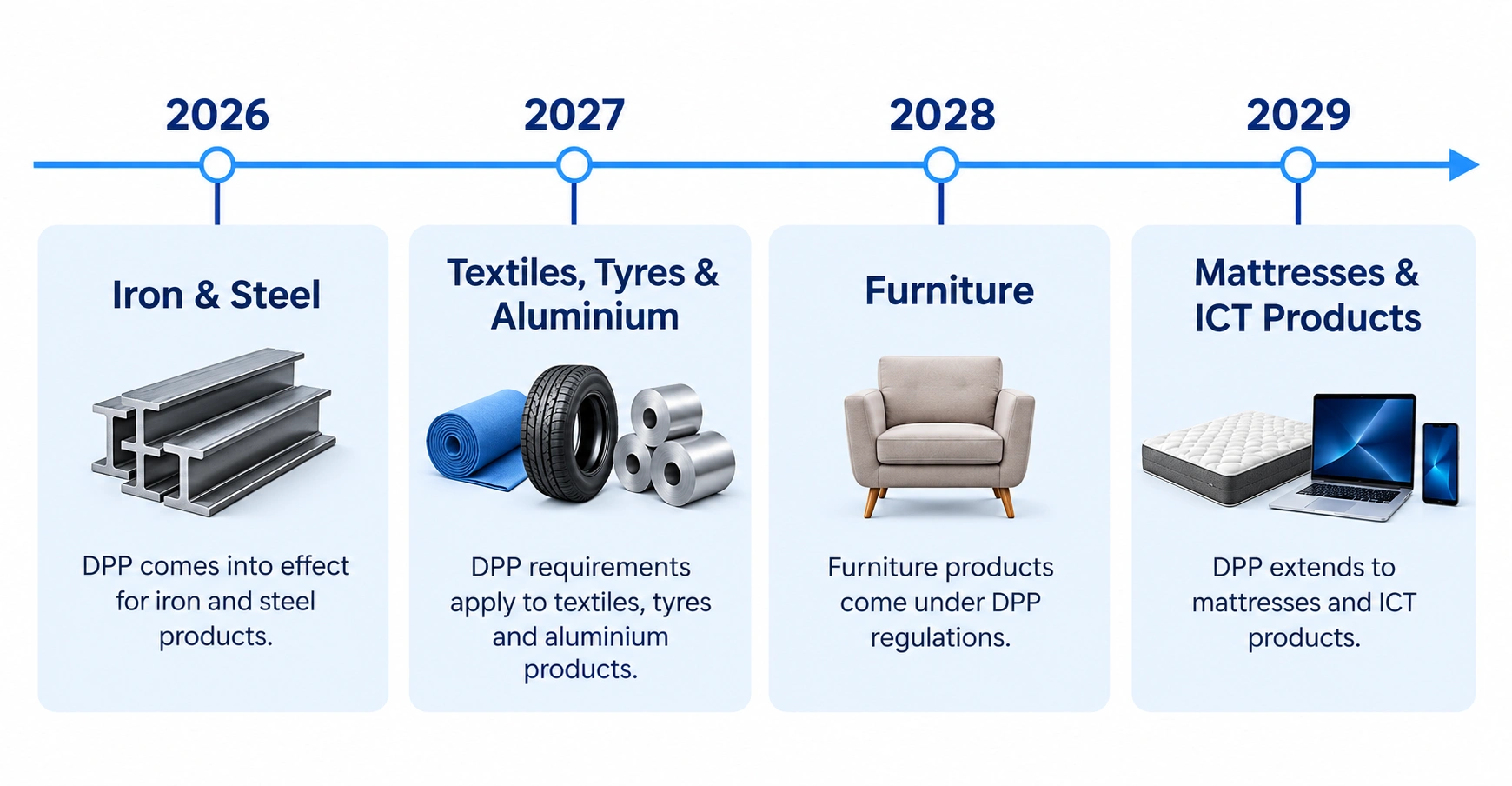
These should not be read as automatic DPP compliance deadlines. Inclusion in the Working Plan means that the product category will be studied and assessed before the final requirements and legally binding dates are established.
Batteries are further ahead. Certain large batteries are expected to require their first DPPs from early 2027 under the Batteries Regulation.
What information will a Digital Product Passport contain?
The exact Digital Product Passport data requirements will vary by product category.
Depending on the applicable rules, the DPP may contain information about product identity, materials and components, durability, repairability, recyclability, usage and maintenance, spare parts, compliance and end-of-life handling.
This means a textile DPP may look quite different from a tyre or electronics DPP. The delegated acts will ultimately determine which information is mandatory for each product group.
Interestingly, businesses may also be able to add voluntary information to the passport, provided it is clearly distinguished from mandatory information and does not affect the accuracy or interoperability of the DPP.
How will users access a Digital Product Passport?
A DPP needs a connection between the physical product and its digital identity. “This is where the data carrier steps in to help!”.
A consumer might scan a code or interact with another carrier on the product to access relevant information. Businesses, authorities and other stakeholders may access different information depending on their role and permissions.
The European Commission is also developing a DPP Registry and Web Portal. The Registry connects unique identifiers with DPP locations, while the Web Portal is intended to provide a public interface for searching product information.
QR Code, NFC or RFID: Which is better for a Digital Product Passport?
There is currently no single technology mandated for every DPP.
The European Commission states that the data carrier will be specified for individual product groups. QR codes and NFC are among the technologies being considered as standards continue to develop.
From an operational perspective, however, these technologies solve slightly different problems.
| Technology | Typical DPP Role | Key Advantage |
| QR Code | Consumer access | Simple smartphone scanning |
| NFC | Digital interaction | Tap-based access |
| UHF RFID | Product identification & traceability | Fast, automated and bulk reading |
A QR code can work well when a customer needs to scan an individual product and access its information.
RFID becomes particularly interesting when the manufacturer also wants to identify and trace that product throughout production, inventory, warehousing or distribution. UHF RFID can identify multiple tagged products without direct line of sight, making it useful for automated product tracking.
This is where an RFID Digital Product Passport approach can provide value beyond simply opening a webpage.
You can also read our guide on how RFID technology works for a better understanding of the technology.
Why can RFID be useful for DPP implementation?
One of the biggest differences between RFID and a conventional visual code is how the physical product can be identified during operations.
Consider a manufacturer handling thousands of products. Individually scanning every QR code during receiving, inventory and dispatch may not always be practical. RFID can enable products to be identified automatically or in bulk while still maintaining a unique identity for each tagged item.
This makes RFID relevant where DPP readiness is being considered alongside product traceability, inventory visibility and lifecycle identification.
For example, tyre manufacturers can use RFID to establish a unique identity that remains associated with a tyre through manufacturing and supply-chain processes. We have explored this further in our article on RFID-enabled tyre traceability and DPP readiness.
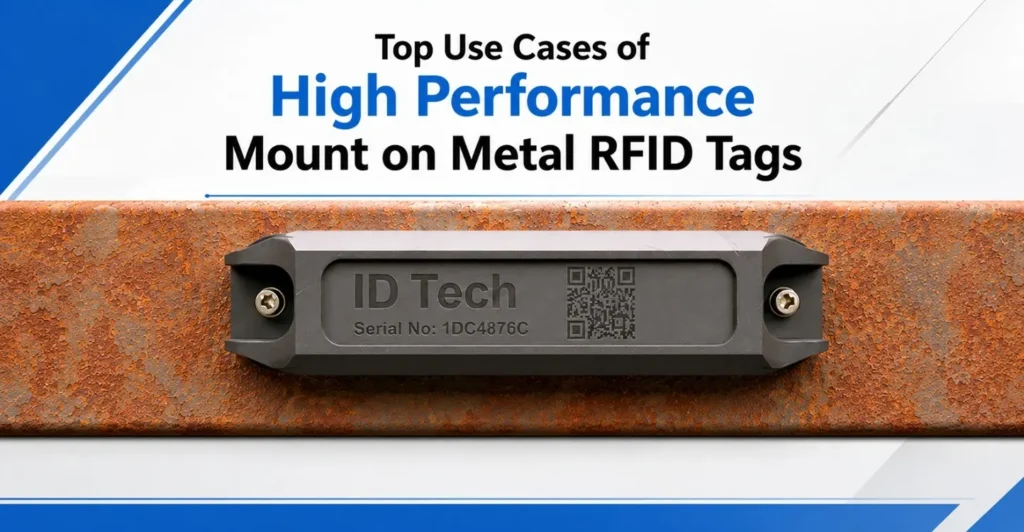
Depending on the application, manufacturers can also evaluate RFID tags for product tracking or RFID inlays and labels.
How should manufacturers prepare for Digital Product Passport implementation?
The first step should not necessarily be choosing a tag or developing new software. It should be understanding your product and your data.
Manufacturers can start by identifying whether their products fall within current or upcoming DPP-related regulations and understanding what information already exists across ERP systems, suppliers, compliance records and product databases.
The next question is how the physical product will be identified. Depending on the eventual requirements, this could be at model, batch or individual item level. The European Commission’s framework specifically recognises identifiers at these different levels.
Once that is understood, businesses can evaluate an appropriate data carrier, conduct a pilot and then look at integration with existing ERP, WMS, MES or other enterprise systems.
In short, DPP implementation starts with data readiness and product identification, not simply with adding a code to a product.
Does Digital Product Passport apply to Indian manufacturers and exporters?
Yes, and this is particularly important for Indian businesses selling into Europe.
DPP requirements are based on products being placed on the EU market, not simply on where they were manufactured.
The European Commission confirms that products imported from outside the EU will also require a DPP when the applicable product-specific legislation requires one. The responsible economic operator must ensure the DPP is available before the product is placed on the EU market.
For Indian manufacturers exporting textiles, tyres, batteries, electronics and other potentially affected products, preparation should therefore start before customers begin asking for compliance.
Frequently Asked Questions
1. What is a Digital Product Passport and why is it important for consumers?
A DPP is a digital identity for a product that provides access to relevant product information. For consumers, this can mean better visibility into materials, durability, repairability, recyclability, environmental information and maintenance instructions where required by the applicable product rules.
2. Why is the Digital Product Passport being introduced?
The DPP is intended to improve product sustainability, circularity, transparency and regulatory compliance while making reliable information easier to exchange across the product lifecycle.
3. Which EU regulation governs the Digital Product Passport?
The main framework is the Ecodesign for Sustainable Products Regulation (EU) 2024/1781, although DPP requirements can also arise from sector-specific legislation such as the Batteries Regulation.
4. When does the Digital Product Passport become mandatory?
There is no single date for all products. Requirements are being introduced progressively through product-specific rules. One confirmed deadline is 18 February 2027 for battery passports covering specified battery categories.
5. Which industries and products are affected first?
Priority areas include iron and steel, textiles, tyres, aluminium, furniture, mattresses, ICT products and energy-related products, while batteries already have a sector-specific passport requirement. The exact obligations depend on the applicable legislation and delegated acts.
6. What information must a Digital Product Passport include?
Requirements will vary by product. Information may include product identification, materials, composition, sustainability information, durability, repairability, recyclability, maintenance instructions, end-of-life guidance and compliance documentation.
7. What technology carries DPP data? Barcode, QR code or RFID?
There is no universal carrier prescribed for every product. Product-specific requirements will determine the appropriate data carrier, and technologies such as QR and NFC are among those being assessed. RFID can additionally support automated identification and traceability where the use case requires it.
8. Why could RFID be useful for DPP implementation?
RFID does not require direct line of sight and UHF/RAIN RFID can identify multiple items automatically, making it useful where DPP identification is combined with inventory, manufacturing or supply-chain traceability. Explore RFID tags
9. How can a small business create a Digital Product Passport?
Start by determining whether the product is or will be in scope, auditing existing product information, identifying missing supplier data and defining how the physical product will connect to its digital identity. SMEs should avoid investing in a complete technical architecture before understanding their product-specific obligations.
10. Does DPP apply to companies outside the EU, including Indian exporters?
Yes. Where a product-specific requirement applies, imported products placed on the EU market also need to comply.
11. How much does Digital Product Passport implementation cost?
There is no standard DPP cost. It depends on product volume, existing IT infrastructure, data readiness, chosen data carrier, tagging requirements, integration and whether identification is required at model, batch or individual-item level.
12. What should a manufacturer do first to prepare for DPP?
Start with a product and data audit, not hardware. Identify applicable regulations, determine what information already exists, map suppliers and understand where product traceability gaps currently exist.
13. What is the difference between a Digital Product Passport and a Battery Passport?
DPP is the wider concept used across multiple product regulations. A Battery Passport is a sector-specific electronic record established under the EU Batteries Regulation for certain battery categories and becomes mandatory from 18 February 2027.
14. What happens if a company does not comply with DPP requirements?
Enforcement will be carried out through Member State authorities and customs. Penalties are set by Member States and must be effective, proportionate and dissuasive. Non-compliant imported products can also face issues entering the EU market.
15. Can a Digital Product Passport help verify authenticity?
Potentially, yes. A globally unique product identifier connects the physical product with its official digital record, while authentication and data integrity are also areas covered by DPP technical standardisation.
However, DPP should not automatically be treated as a complete anti-counterfeiting system. The level of authentication depends on the identifier, carrier and security architecture used.
Preparing for DPP Starts Today
Digital Product Passport requirements are still developing, but manufacturers do not need to wait for every final rule before preparing.
The immediate focus should be on understanding product data, improving traceability and evaluating how physical products can remain reliably connected to their digital identities.
For Indian manufacturers exporting to Europe, starting early can make future DPP compliance much easier to manage.
ID Tech works across RFID tags, inlays, readers and traceability solutions that can support product identification across manufacturing and supply-chain environments. Explore our RFID Tags and RFID Inlays & Labels to understand the available identification options.