Retail inventory looks simple from the outside. A product comes into the store, goes on the shelf and gets sold. But anyone working with inventory knows that the actual process is much more complicated.
Products get misplaced. Stock gets moved without being updated in the system. Manual counts take time, and sometimes the system says an item is available when it is nowhere to be found.
This is exactly where an RFID inventory management solution can make a difference.
RFID allows retailers to identify multiple products without scanning every barcode individually. With item-level UHF RFID, hundreds of tagged products can be identified quickly, giving retailers much better visibility of what is actually available in the store, stockroom or warehouse.
And this is not just a theoretical use case.
Global retailers such as Decathlon, Walmart, and Zara have been using RFID retail solution for years. Their experiences demonstrate why inventory accuracy has become one of the strongest business cases for RFID.
Why Is Inventory Accuracy Such a Big Problem in Retail?
Inventory accuracy simply means how closely the stock shown in your system matches the stock physically available.
This matters because almost every retail decision depends on that number.
If the system shows ten pieces but only six are actually available, replenishment, online orders, store transfers and customer promises are all being made using incorrect information.
Research from the Auburn University RFID Lab has shown how significant this problem can be. Across numerous retailers studied by the lab, average inventory accuracy was around 60%, while RFID pilots and early deployments increased inventory accuracy to more than 95%.
The same research also points out something important: better inventory data affects much more than stock counting. It supports fewer out-of-stocks, better replenishment and a stronger omnichannel experience.
That is why RFID in retail should not be looked at simply as a faster barcode.
It creates a better inventory data layer.
How RFID Improves Inventory Accuracy
With a barcode system, an employee normally needs to locate an item, point the scanner towards the barcode and scan it individually.
UHF RFID works differently.
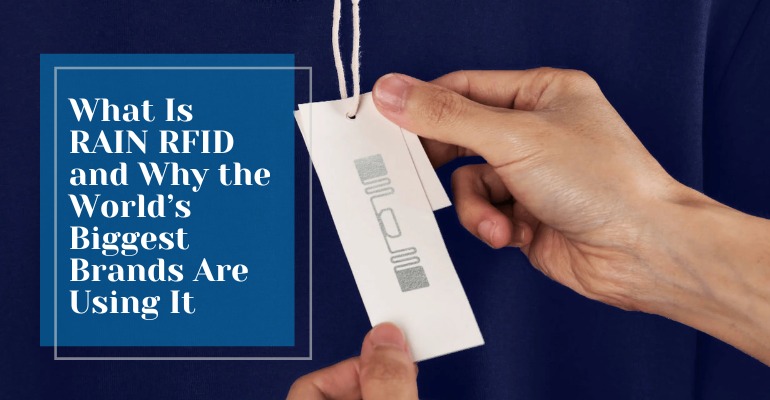
Every product carries an RFID tag with a unique identification number. An RFID reader communicates with these tags using radio waves and can identify many tagged products without requiring direct line of sight.
A typical retail setup can include:
- UHF RFID garment tags or labels on individual products
- Handheld RFID readers for cycle counting and item search
- Fixed RFID readers at receiving, dispatch or transition points
- RFID-enabled POS or self-checkout systems
- Inventory software connected with ERP, POS or WMS platforms
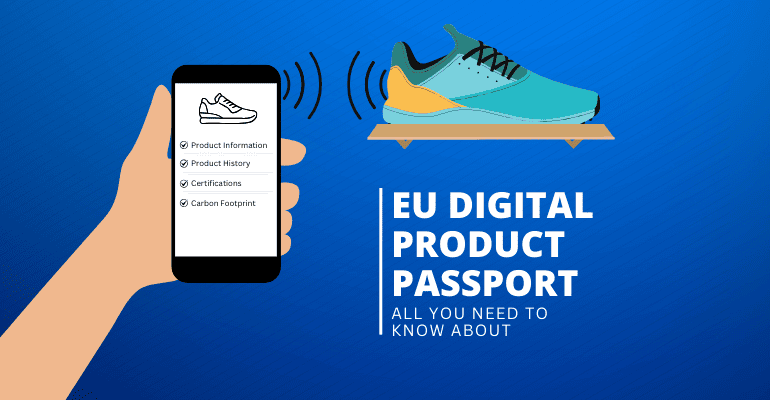
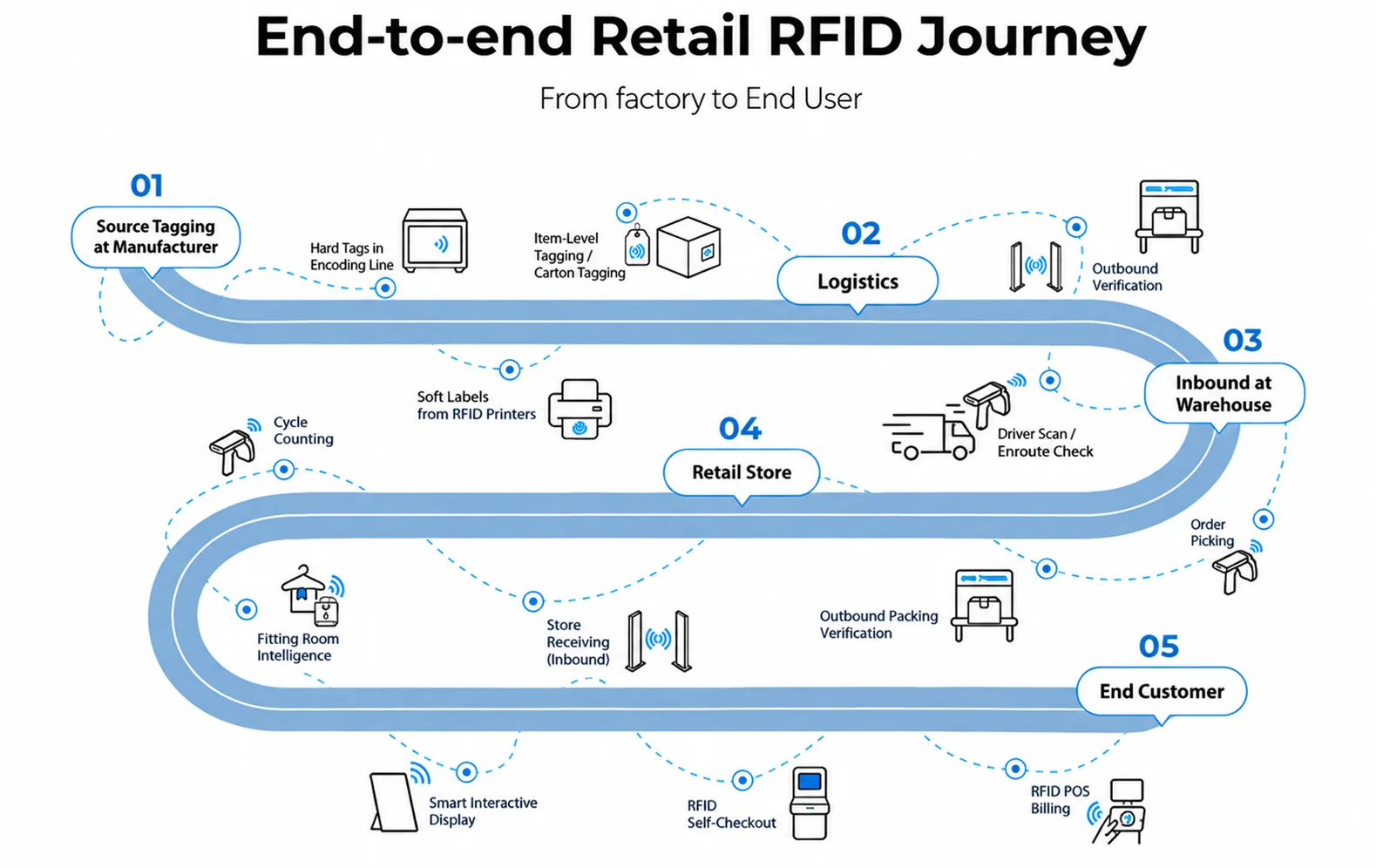
The result goes far beyond faster stock counts. RFID creates visibility across the entire product journey, from source and warehouse movement to store inventory, customer interaction, checkout, returns and eventually end-of-life.
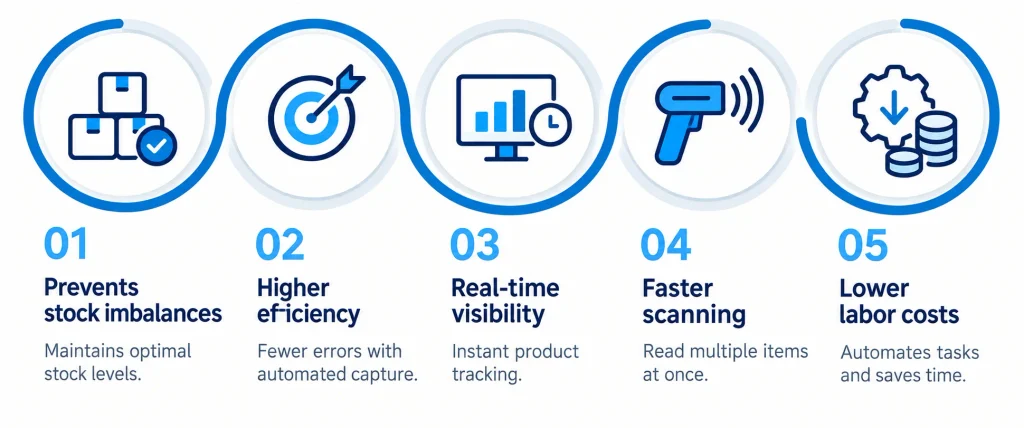
For retailers, this means fewer inventory gaps and faster replenishment. For customers, it means better product availability, easier item search, faster checkout and a smoother shopping experience. With frequent, automated data capture, inventory stays more accurate throughout the product lifecycle instead of being corrected only during periodic stock counts.
Decathlon RFID Case Study: RFID From Factory to Checkout
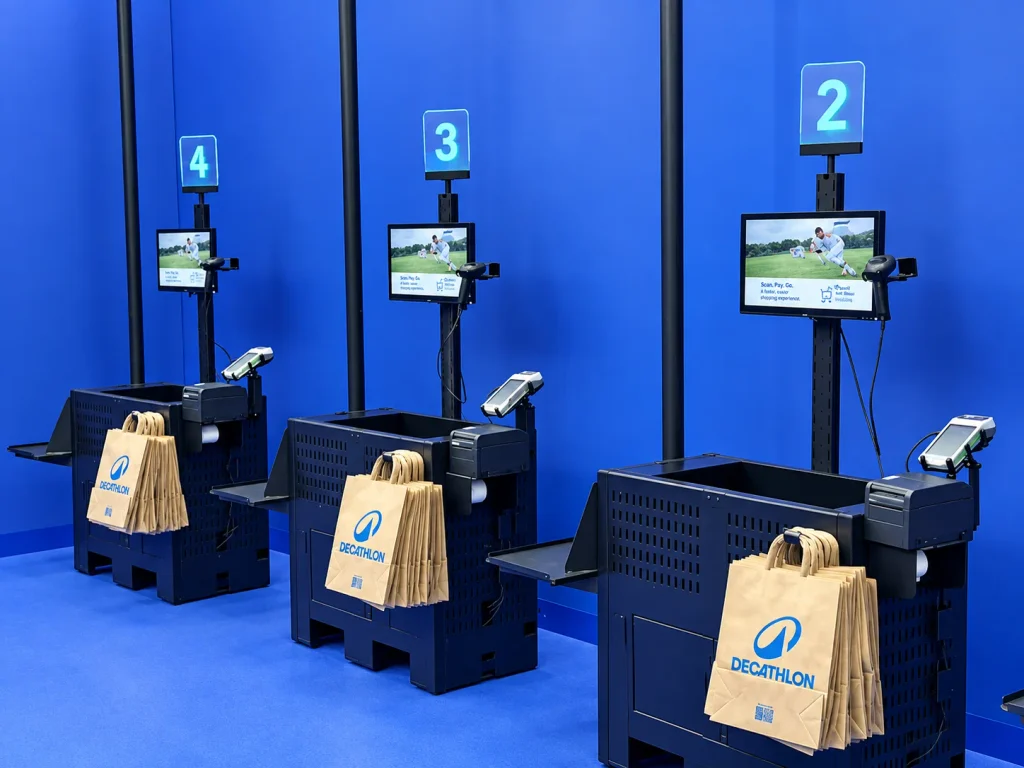
Decathlon is probably one of the easiest RFID in retail examples for customers to see themselves.
Walk into many Decathlon stores and you may notice that checkout works differently. Instead of scanning every item’s barcode, products can be placed together inside an RFID-enabled checkout area and identified automatically.
But checkout is only one part of Decathlon’s RFID system.
Decathlon began experimenting with RFID in the late 2000s and moved towards a large-scale rollout in 2014. According to Decathlon’s own published RFID history, the technology was expanded across manufacturing, logistics and sales.
The company explains that RFID tags can be read from up to around one metre away, with hundreds of tags being read in a second. This makes stocktaking considerably faster than scanning products one by one. By 2019, Decathlon reported another important milestone: 100% of its own-brand products leaving its factories were equipped with RFID tags.
What Does Decathlon Use RFID For?
RFID follows the product through multiple stages of its journey.
At the manufacturing level, products receive RFID identification. Warehouses and stores can then use RFID readers to identify those products during logistics and inventory operations. Inside stores, employees can perform much faster inventory counts using RFID readers.
The same RFID identity can then support the customer-facing side of retail through RFID self-checkout.
The interesting part of the Decathlon case is that RFID is therefore not limited to one isolated application. The same technology supports traceability, inventory, replenishment and checkout. Decathlon’s current retail operations also reference RFID inventory cycles designed to maintain 99%+ stock accuracy.
That is what a scaled RFID implementation looks like: not simply installing an RFID reader, but building RFID into the product’s complete journey.
Walmart RFID Inventory Management: One of Retail RFID’s Earliest Large-Scale Cases
It is difficult to talk about RFID in retail without talking about Walmart.
Walmart was one of the companies that pushed RFID adoption into mainstream retail and supply-chain discussions in the early 2000s.
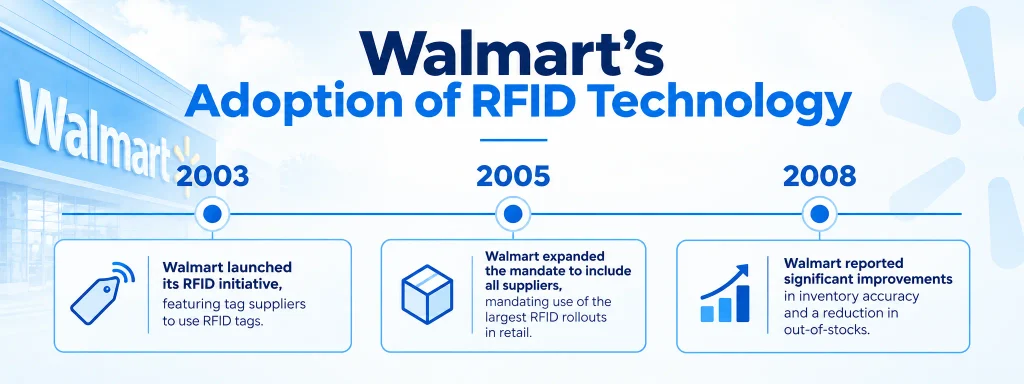
2003 | RFID Initiative Begins
Walmart announced its RFID initiative, asking its top 100 suppliers to apply RFID tags to cases and pallets.
2005 | RFID Rollout Expands
RFID deployment expanded across suppliers and distribution operations, increasing supply chain inventory visibility.
2008 | Measurable Retail Impact
RFID supported operations showed better inventory visibility and fewer out of stocks, strengthening replenishment efficiency.
Walmart’s RFID Journey Is Still Expanding | The 2026 Vision: Fresh Foods & Automotive
Walmart’s RFID journey continues to expand into areas such as fresh foods and automotive operations. The focus is moving beyond inventory visibility toward combining RFID with sensor technologies to improve product traceability, reduce waste, enhance safety and create more efficient operations across the product lifecycle.
Zara RFID Technology: Connecting the Store and Online Inventory
Fashion retail has a unique inventory challenge. Multiple sizes, colours, store transfers, returns and online orders make it difficult to know exactly what is available and where.
Zara uses RFID to create that visibility across stores and online inventory. The impact has been significant, with a 17% sales boost in the first six months, 19% reduction in overstock and a 7.5% increase in annual profits.
What Changed Inside Zara Stores?
At one major Madrid store, inventory counting previously required 40 employees for five hours. With RFID, 10 employees completed it in about half the time, while inventory accuracy has been reported at above 98%.
The bigger value is what happens after the count. Better visibility means faster replenishment, easier product search, more reliable online fulfilment and a better customer experience. Zara’s RFID implementation has also been reported to deliver around $400 million in annual savings.
Decathlon vs Walmart vs Zara: What Can We Learn?
Although all three retailers use RFID, their journeys are not identical.
Decathlon uses RFID across the complete product journey, from manufacturing to self-checkout. The impact included 9% lower shrinkage, 5× faster inventory counts and around 2.5% sales growth.
Walmart used RFID to improve stock visibility and replenishment. Studies showed around 30% fewer out-of-stocks for selected product categories, helping prevent lost sales.
Zara connected store and online inventory through RFID, reporting 19% lower overstock, 7.5% higher annual profits and around $400 million in annual savings.
The common factor is inventory visibility.
None of these retailers adopted RFID simply because reading tags is faster than scanning barcodes. The real value comes from knowing what inventory exists, where it exists and when it moves.
What Hardware Is Used in a UHF RFID Retail Inventory Solution?
A retail RFID system does not require the same hardware at every point.
The architecture depends on what the retailer wants to automate.
1. RFID Tags
Each item needs a suitable RFID tag or RFID label carrying its unique identity.
For apparel, lightweight UHF garment labels or hang tags are commonly used. Other products may require different tag designs depending on material, packaging and required read range.
Tag selection is important because an RFID tag that works well on a garment may not perform the same way near metal, liquid or other RF-sensitive materials.
2. Handheld RFID Readers
A handheld RFID reader is one of the most useful devices for retail inventory.
Employees can walk through the store or stockroom and identify many products without individually handling every item.
Handheld readers can support cycle counting, item search, stock verification, replenishment and receiving.
3. Fixed RFID Readers
Fixed readers can automate RFID data capture at specific locations.
For example, readers and antennas can be installed around warehouse or stockroom entry/exit points to record tagged products moving through the area.
This reduces dependence on employees remembering to scan every movement.
4. RFID Software and Integration
Hardware alone does not create inventory visibility.
RFID data needs to be connected with the retailer’s inventory platform, ERP, POS or WMS
The software determines what each tag represents and converts RFID reads into useful events such as:
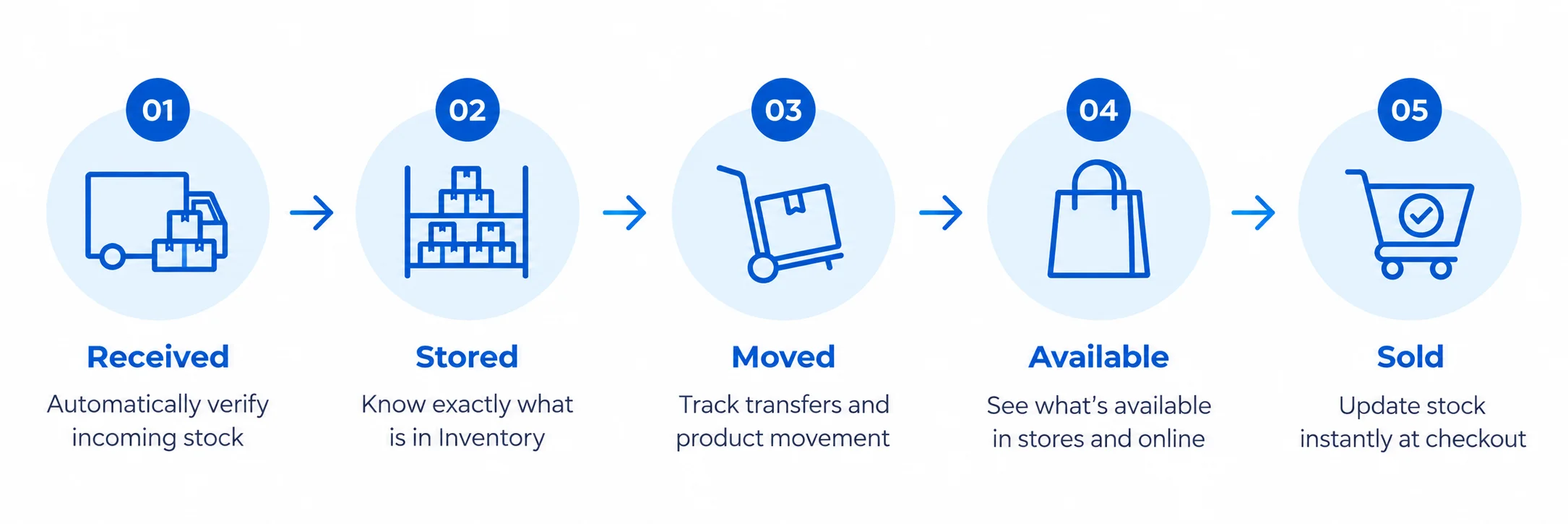
This integration is what turns RFID reads into usable inventory information.
RFID Can Go Beyond Inventory Counting
Once item-level RFID is available, retailers can build additional applications on top of the same infrastructure.
An RFID checkout bin, for example, can identify several products placed inside it at the same time instead of requiring customers to scan every barcode.
A smart fitting room can identify garments brought into the fitting area and display product information, available sizes or related products.
RFID can also support loss prevention, automated receiving, stockroom-to-floor replenishment and omnichannel fulfilment.
But these applications depend on one thing first: reliable inventory data.
Building an RFID Inventory Management Solution With ID Tech
At ID Tech, we work with RFID across the complete identification layer, from tags and readers to antennas, handheld devices and application-specific systems.
Our RFID portfolio includes 150+ RFID tag types, including garment, jewelry, on-metal, pallet and industrial tags, along with fixed, handheld, integrated and desktop RFID readers.
For high-volume environments, solutions can be designed using devices such as the IDT-401 C UHF 4-Port Reader, which uses an Impinj E710 module and supports reading speeds of 1,300+ tags per second.
For retail teams that need mobility, handheld RFID readers can support inventory counts, product search and stock verification directly on the shop floor.
And where the requirement extends beyond inventory, the same RFID ecosystem can support applications such as RFID self-checkout, smart fitting rooms, RFID Tunnel, RFID Encoding Bins, RFID based Smart Interactive Display, warehouse management, and automated track-and-trace.
Planning an RFID inventory project?
Start with the process, not the hardware.
Identify where inventory errors happen today, what level of visibility you need and which processes you want to automate. ID Tech can then help evaluate the right RFID tags, readers, antennas and system architecture for the application.