A normal school or university day involves hundreds of repetitive transactions. Students enter the campus, attendance is recorded, vehicles are verified, books are issued, laboratories require controlled access, and assets move between departments.
When these processes depend on registers, manual ID checks or separate systems, delays and errors become difficult to avoid.
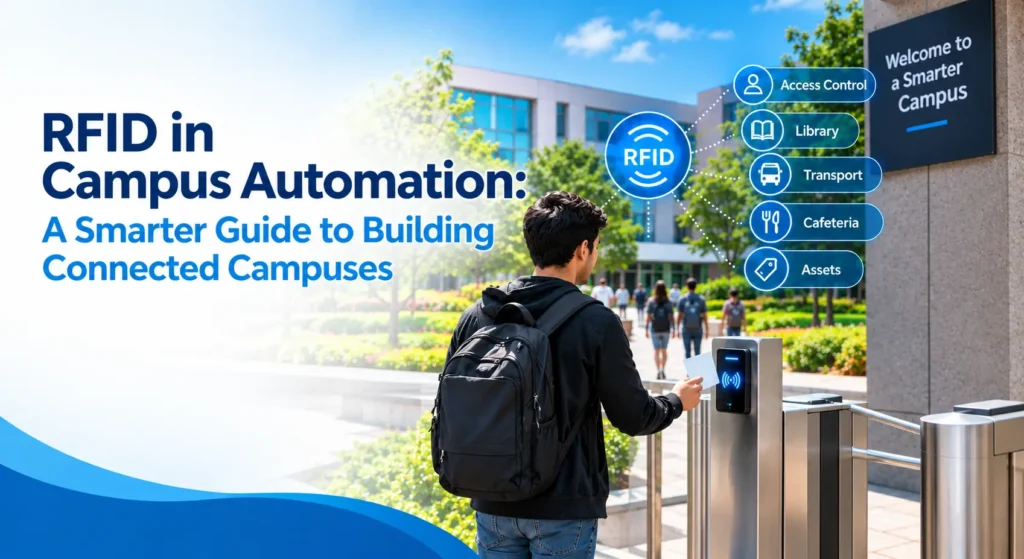
RFID in Campus Automation connects students, staff, books, assets and vehicles with digital campus records. It can automate attendance, access control, library operations, asset management and vehicle entry while creating a more connected smart campus ecosystem.
ID Tech’s RFID Campus Automation Solution brings these functions together through RFID hardware, entrance automation and integrated software.
How RFID Tags for Campus Automation Work
RFID uses radio waves to identify tagged objects or credentials without requiring direct line-of-sight scanning like a barcode.
However, there is no single RFID technology suitable for every campus application.
Active vs Passive RFID Tags for Schools
Passive RFID tags have no internal battery and receive power from the RFID reader. They are commonly used for student cards, library books, assets and vehicle identification.
Active RFID tags have their own battery and can transmit over longer distances. They are more suitable when continuous or longer-range identification is required but involve higher tag costs and battery maintenance.
For most campus applications, passive RFID provides a practical combination of scalability, low maintenance and flexible form factors.
Choosing the Right RFID Frequency
Different campus applications require different RFID frequencies.
HF/NFC is suitable for close-range applications such as student cards, library transactions and controlled access. UHF RFID provides longer read ranges and can be used for vehicle identification, campus asset management and selected hands-free applications.
A campus can therefore use HF smart cards for students, RFID labels for books, UHF asset tags for equipment and windshield tags for vehicles.
When a reader captures an RFID tag, the software verifies it against the relevant database and triggers an action such as recording attendance, issuing a library book, authorizing entry or updating an asset record.
Why RFID Supports Modern School Security
RFID makes campus security more automated by connecting each credential with an authorized digital identity.
RFID credentials can be mapped to students, employees, vehicles or assets. The system can verify whether that credential is authorized before allowing access or completing a transaction.
For higher-security applications, institutions can use smart-card technologies supporting authentication and encrypted communication. Access permissions, database verification and transaction logs can further strengthen the system.
Every RFID interaction can also create a time-stamped digital record, providing an audit trail for gate access, library transactions and restricted-area entry.
Key Benefits of an RFID Student Attendance System
Automated Attendance
An RFID student attendance system can automatically record attendance when a student presents an RFID credential or passes through a configured identification point.
Attendance events can also be connected to a student tracking system with SMS alerts, allowing parents or guardians to receive notifications when students enter or leave campus.
Better Library Operations
RFID reduces repetitive manual work involved in issuing, returning, finding and auditing books. Self-service and automated inventory processes can also help library staff spend more time assisting students instead of handling routine transactions.
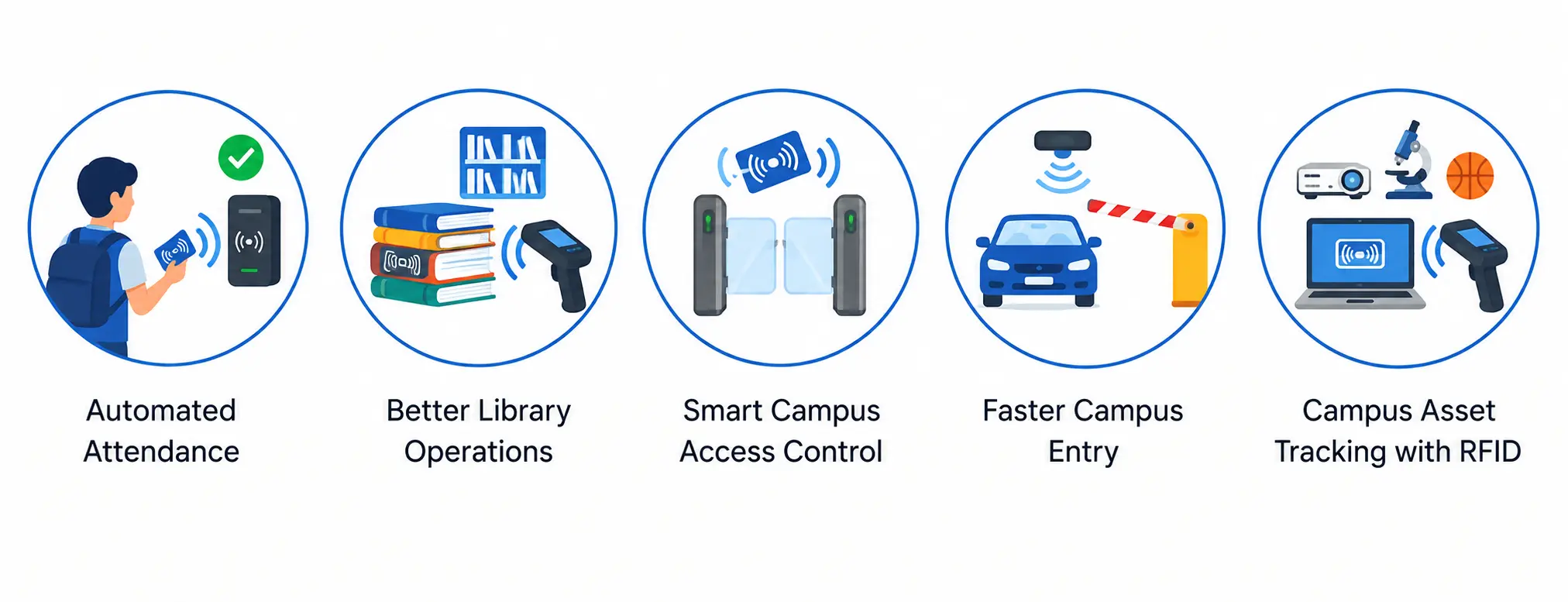
Smart Campus Access Control
RFID cards can work with turnstiles, flap barriers, electronic doors and access-control systems.
Permissions can be configured for classrooms, laboratories, hostels, libraries and administrative areas.
Faster Campus Entry
For parking and vehicle gates, UHF windshield tags can be identified from a longer distance.
The system verifies the vehicle and can automatically trigger a connected boom barrier or entrance automation system.
Campus Asset Tracking with RFID
Laptops, laboratory instruments, projectors, sports equipment and other assets can be RFID tagged.
Using RFID handheld readers, campus teams can conduct faster physical audits, identify misplaced equipment and maintain updated asset records.
Institutions managing large asset inventories can further integrate this with an RFID Fixed Asset Tracking Solution.
Campus Ecosystems Benefiting from RFID Automation
School and University Gates
RFID readers can be integrated with turnstiles and flap barriers for student and staff access. UHF readers, windshield tags and boom barriers can automate vehicle entry.
RFID Library Management System
An RFID library management system can automate book issue, return, inventory and security.
ID Tech’s RFID Library Automation Solution includes RFID book labels, staff stations, self-service kiosks, handheld readers and anti-theft gates.
Students can issue and return books through self-service kiosks, while handheld RFID readers help librarians perform inventory and locate misplaced books. RFID security gates can detect unauthorized movement of appropriately configured library items.

Laboratories and IT Rooms
RFID access control can restrict entry to authorized students and staff, while tagged equipment can be digitally issued, returned and audited.
Cashless Campus Payment Solution
The same student credential can also identify a student within a cashless campus payment solution for cafeterias, printing, bookstores or other campus services.
The RFID card identifies the user while balances and transactions are managed by the connected payment platform.
Campus Fleet and Parking
Cars, buses and authorized service vehicles can be fitted with UHF windshield tags.
At the entrance, the RFID reader verifies the vehicle against the campus database before granting access.
Components of an Effective RFID Campus Automation System
A successful campus RFID deployment requires the right combination of hardware, software and integration.
RFID Tags and Cards
The tag should always match the application:
- HF/NFC cards: Student IDs and close-range access
- HF RFID labels: Library books
- UHF tags: Assets and longer-range identification
- UHF windshield tags: Vehicle access
- On-metal RFID tags: IT and laboratory equipment
ID Tech offers multiple RFID tags and smart cards for these applications.
RFID Readers and Antennas
Fixed readers can automate gates and defined checkpoints, while desktop readers can be used for credential enrollment and encoding.
Handheld readers are useful for library inventory and campus asset audits. UHF applications also require correctly selected antennas to create reliable read zones without unnecessary reads from surrounding areas.
Entrance Automation
RFID readers can integrate with turnstiles, flap barriers and boom barriers.
The process is simple:
RFID Credential → Reader → Authorization → Gate/Barrier Opens → Transaction Recorded
Backend Software and Middleware
The software layer connects RFID hardware with the institution’s Student Information System, ERP, library software, access-control database or notification platform.
This is what turns an RFID read into a useful campus action.
Planning campus automation? Explore ID Tech’s RFID Campus Automation Solution to identify the right combination of RFID cards, tags, readers and entrance automation for your institution.
Future of RFID in Smart Campus Transformation
The future of campus automation will involve more integration between RFID, IoT, mobile credentials and data analytics.
RFID data can help institutions understand attendance patterns, facility utilization, asset movement and peak entry periods. When combined with appropriate privacy and data-governance controls, this can support better operational planning.
Campuses can also combine physical RFID cards with smartphone-based NFC credentials. Instead of maintaining separate identification systems, institutions can gradually move toward a connected one-card campus ecosystem for access, library services, payments and other student services.
Building a Smarter, Connected Campus
RFID campus automation is not simply about replacing an ordinary student ID with an RFID card.
It is about identifying repetitive campus processes—attendance, access control, library operations, asset tracking, parking and campus services—and automating them using the right RFID technology.
With the right combination of RFID tags, smart cards, readers, antennas, entrance automation and software integration, institutions can build a more connected, secure and efficient campus.
Want to see how RFID can work across your campus? Talk to ID Tech’s RFID team or book a customized RFID campus automation demo.
Frequently Asked Questions
1. What is the difference between RFID and biometric campus systems?
RFID identifies a credential, while biometric systems verify physical characteristics such as a face or fingerprint. Both technologies can also be combined where additional identity verification is required.
2. How long do RFID student cards and asset tags last?
Passive RFID tags do not require batteries. Their service life mainly depends on tag construction, environmental conditions and physical handling.
3. How secure is RFID against proxy attendance?
RFID can automate attendance, but a card alone cannot prove who is carrying it. Higher-security systems can combine RFID with photo verification, controlled gates or biometrics.
4. Can RFID prevent asset theft and unauthorized entry?
RFID can support access control and asset-movement monitoring. Its effectiveness depends on reader placement, software rules and integration with the overall physical-security system.
5. Can RFID tags be read while moving?
Yes. Properly designed UHF systems can identify moving tags and vehicles, while HF/NFC is generally used for intentional close-range interactions.
6. What is the RFID read range?
HF/NFC is primarily used for short-range applications such as cards and library transactions. UHF RFID can operate over several metres depending on the tag, reader, antenna, environment and permitted transmit power.
7. What happens if a student loses their RFID card?
The credential can be disabled in the campus database and a replacement card assigned to the student’s existing profile.